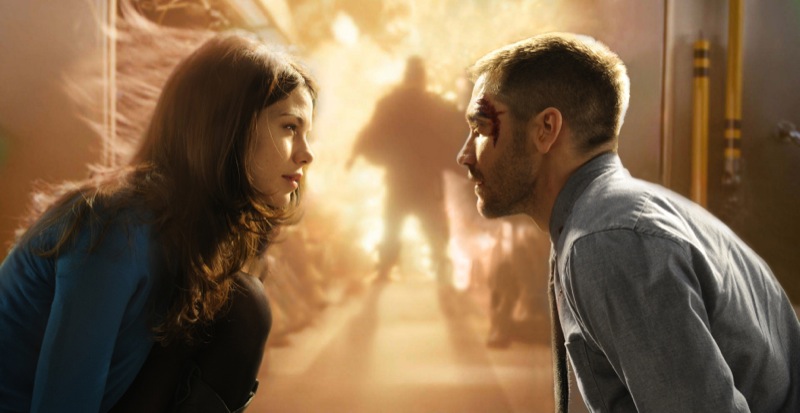
Yesterday, director Duncan Jones live-tweeted his most recent film, Source Code1, as it played on BBC’s Channel 4 in the UK. He answered viewer questions, divulged some of his technique and pointed to the true story one of the film’s characters is based on.
The whole stream is a fun (and spoiler-ridden) read. I’ve collected the whole thing in a Storify stream, but below you can find a selection of my favorite tidbits. Perhaps worth bookmarking for the next time you watch the film.
On Plato:
Question if Plato’s cave was an influence… not specifically, though I was a big Plato lover growing up… subliminal maybe. #SCch4
— Duncan Jones (@ManMadeMoon) February 3, 2013
On Sam Beckett’s cameo:
Being asked if Quantum Leap was an inspiration… All I can say is wait to hear Colters dad on the phone.;)#SCch4
— Duncan Jones (@ManMadeMoon) February 3, 2013
Scott Bakula plays the voice of Colter’s father.
Quan-Tomb:
Theres a lovely hidden clue in the set where Vera is that unfotunately never made the cut.The computer nearby has a title on it… #SCch4
— Duncan Jones (@ManMadeMoon) February 3, 2013
“Quan-Tomb” is the name of the large computer array to Vera’s left, running the SC program.Written in big letters, but off camera! #SCch4
— Duncan Jones (@ManMadeMoon) February 3, 2013
On the 8-minute time limit:
Asked why 8 minutes?Well, need to keep the time frame short enough that there is urgency, but long enough to get something done!#SCch4
— Duncan Jones (@ManMadeMoon) February 3, 2013
On Jeffrey Wright’s exposition:
Producers understandably wanted to make sure audience was clear on SC tech… problem is, what Rutledge says is empirically WRONG! #Scch4
— Duncan Jones (@ManMadeMoon) February 3, 2013
On product placement:
Asked who actually uses Bing………. people who want money to make their movie look better use Bing. ;) #SCch4
— Duncan Jones (@ManMadeMoon) February 3, 2013
On set design:
Pod just stretched again!Now its in “medieval prison cell mode” as we called it.Little light in the top like an old Flynn movie #Scch4
— Duncan Jones (@ManMadeMoon) February 3, 2013
On making a fake train station and van:
Story time.. HUGE mistake in production coming up.. We lost our location for the train station.Was going to use a real one #SCch4
— Duncan Jones (@ManMadeMoon) February 3, 2013
but place changed terms at the last minute so we had to come up with an alt.. ended up BUILDING a train platoform in a parking lot #SCch4
— Duncan Jones (@ManMadeMoon) February 3, 2013
cause everything was so last minute, didnt get inside of the van sorted out in time for the shoot!All that crap in the van?VFX! #SCch4
— Duncan Jones (@ManMadeMoon) February 3, 2013
stars and stripes box was real… thats it. #SCch4
— Duncan Jones (@ManMadeMoon) February 3, 2013
On that villain:
Asked what the inspiration for the villain was…. a doc called “The radioactive boyscout”Check it out.Bizarre and terrifying. #SCch4
— Duncan Jones (@ManMadeMoon) February 3, 2013
The Radioactive Boy Scout2 is actually the name of a book by Ken Silverstein expanded from this 1998 article in Harper’s. It tells the story of David Hahn, an American Boy Scout who nearly build a homemade nuclear reactor when he was 17. The Nuclear Boy Scout is the TV documentary Jones is referring to. It aired on BBC’s Channel 4 in 2003 but is yet to air in the US.
That ain’t bullet time at the end:
The freeze was GREAT fun!:)A little post touching up, but mainly just actors staying still while camera tracked back!#sourcecode
— Duncan Jones (@ManMadeMoon) February 3, 2013
Further Reading:
- I reviewed Source Code when it premiered at SXSW in 2011 and interviewed Jack Gyllenhaal about the role.
- Probably my favorite Source Code-related out there is Eric Kohn’s physicist father explaining that science in the film basically checks out.
- Bookmark the full Storify stream if you want to time-shift Jones’ commentary.