A Decade Ago on the Internet
For the first time in forever I visited the popular links page over on Pinboard, where the site’s most bookmarked URLs are displayed for public perusal. A few dozen users bubbled a recent Tim Bray article, “Google Memory Loss,” up near the top and it hit a soft spot in me. Here’s the thesis:
I think Google has stopped indexing the older parts of the Web.
Bray goes on to prove it and offer alternatives, namely DuckDuckGo (my preferred search engine) and Bing. Anecdotally, this comports with my own experience online and reminded me of a defunct little project I’ve been thinking about lately.
For three brief installments in 2013, I had a look-back column here called Hindsight. The idea was to read year-old stories and find at least one article on the web at least a decade old. It was an attempt to step away from the daily firehose of current events (already a problem back then; today, a national crisis) and learn something new. Far and away, the most interesting part of this short-lived exercise was finding really old stuff on the web.
I had a few little tricks to discover aging content back then, including using Google’s date range search tool. Trying to use the same tool again this week brings up precious few useful results. From the outside looking in, it feels as though Google is discarding the early web. Which is strange given the company’s supposed raison d’être of organizing the world’s content.
But all is not lost! In search of what was happening this week on the web ten years ago, I started visiting older blogs whose owners have been responsible stewards of their archive. First up was Kottke.org. Imagine my surprise when I saw that Jason had taken the third week of January 2008 off and handed the site over to…Awl co-founder Choire Sicha! The Awl shuttered yesterday, as did sister site The Hairpin.1 It’s a blow to independent publishing, but also a straight-up bummer to anyone who’s been reading online for more than a few years. We’ve already had to live without a Gawker, now this?
Oh, back to ten years ago this week.
Sicha spent the better part of January 17, 2008, sharing stories of New York City during the early 1990s, apparently research for something I haven’t quite been able to figure out. The wildest, I think, was a 1991 New York Times article on East Village apartment owners desperately trying to sell their abodes (in one case to the tune of a $100,000 loss) with no takers.
The topics bob and weave all over the map throughout the week. There are two posts that ponder whether it was too soon for Cloverfield after 9/11 (and a third that considers the same topic as it relates to a Laurie Anderson live album). He alerts readers to Apple’s introduction of iTunes movie rentals and complains about the lack of copy-paste on iPhone.
In a strange confluence of my own recent interests, Sicha points to news of work on a musical version of Armistead Maupin’s Tales of the City. I had never heard of Maupin until a few weeks ago, when PBS aired The Untold Tales of Armistead Maupin (still waiting for me in my DVR queue) and I grabbed the first volume of Tales from the library. (I’ve started out my year with an interest in serialized fiction.) Anyway, the musical ended up premiering in 2011, called by SFGate theater critic Robert Hurwitt “a blithe, comic and pleasantly tuneful celebration of sex, drugs and all kinds of coming out in freewheeling, pre-AIDS San Francisco circa 1976.”
The web has changed dramatically in the decade since Sicha’s week on Kottke.org. It’s a blogging style (furious, scattershot, immediate) the modern reader may not even recognize. And if Google really has stopped indexing the older bits of the web, it’s a style the future reader may not have the chance to consider.
I guess it’s incumbent upon the rest of us to keep that corpus relevant. The Internet Archive does the hard work of preserving the web as it was2 and, as Bray mentioned in his article, other search engines are doing much better than Google. But an archive is nothing if it’s not gone through every once in awhile, just as an unused library serves merely as a warehouse.
I know I learned a great deal from looking at just one site as it was a decade ago. I’m curious to hear if others find this interesting as well. As I mentioned above, I’ve been thinking about the Hindsight column that I never really pursued. If I started it again today, I would probably focus only on stories published at least ten years ago. I’d like to be a bit more deliberate about it this time around, and it would help to hear if people would want to read something like this regularly. Would you want to read it here? A new site? In the oh-so-of-the-moment newsletter form? Let me know what you think in the comments or on twitter or drop me a line. Or just come back again soon to see where this goes.
-
The Awl’s final post was also a popular Pinboard pin! ↩︎
-
I don’t recall what Kottke.org looked like in 2008, but here’s a 2009 grab of one of this week’s decade-old articles. ↩︎
Is it Worth Watching a Cropped Movie?
This A.V. Club story on a Patrick (H) Willems YouTube video about aspect ratios scratches at an itch I’ve been having lately: why on earth does HBO in particular crop most films to 16:9?
I think Willems goes a bit too far in his video, starting with the title, “HBO is Ruining Movies.” Cinema tends to be more than the sum of its parts, so if someone watches a film in a different aspect ratio than it was shot for, they still watched the movie. Stories are able to break through whatever impediments get thrown in their way. So HBO isn’t ruining, say, the Harry Potter franchise by cropping the sides of the film off, but it certainly isn’t offering up the ideal viewing experience either.
A great, concise explanation of how cropping can change a film comes by way of a 1990 “At the Movies” discussion between Roger Ebert and Gene Siskel (uploaded and brought to light again by Todd Vaziri). They use the example of Indiana Jones and the Last Crusade, projected originally at 2.39:1, being re-edited to fit on 4:3 home video screens. It’s a damning breakdown of how a director’s vision being muddied by studios out to move some VHS tapes.
In the era of 4:3 screens I can see why studios made the call to release films cropped. Most homes didn’t have a very large set, and the resolution was so low to begin with, most viewers would be upset to see their film scaled down at all.
But those days are gone. Not only are almost all TV sets now 16:9, but they’re pretty darn big too. Even cropping all the way down to 2.39:1 would still leave a pretty huge image side-to-side.
So why does HBO persist in cropping? Maybe people want every pixel of their widescreen TVs filled up or they feel they’re not getting their money’s worth? Does HBO have research/polling on this? Or maybe studios deliberately offer up the cropped versions to cable streamers so they can milk extra bucks off rentals and purchases. You want the full picture? Pay up.
Why not solve this by offering both options on streaming services? Why not build a setting in that says you always prefer a full, widescreen picture at the original aspect ratio? On a phone you can easily zoom an image to fill the screen if you prefer not to see any letter-/pillar-boxing. Shouldn’t this be available on TV sets as well?
Willems mentions in his video that anytime he goes to watch a film, he first visits the “Technical Specs” heading on IMDb to check if the version he’s watching is in the correct aspect. If it’s not, he’ll stop watching. I used to do this, but I’ve loosened up. I recommend others do, too.
I grew up in the VHS era. The only time I ever saw letterboxing on films was if my father stopped at TLA Video (sadly, now defunct) in center city Philadelphia for a hard to find film. Almost every film I watched at home was cropped. And yet, my love of movies persists. I can still remember wearing out 4:3 cropped tapes of widescreen films, memorizing lines and falling in love with the story all over again. At this point, it’s silly that HBO and others are putting up cropped versions of films, but I’d rather watch something than nothing at all.
2017 in Film
I had an idea for a story in college. Terrorists blow up the Academy Awards, killing off a generation of filmmakers. (The “In Memoriam” the following year would be three hours long, I so brilliantly quipped.) Our story picks up in the aftermath, following the son of a famous filmmaker who is asked to helm a large project in hopes of getting the movie business back on track. In my view, this could be a comedy, but I couldn’t figure out how to keep things light knowing that the deaths of a few hundred or thousand people move our plot forward, so it went abandoned.1
Recently, though, I’ve been thinking about this story a great deal. Harvey Weinstein was the bomb that went off inside Hollywood. His transgressions and crimes have touched the entire industry. I’m no scholar of Hollywood history but this moment feels like nothing that has ever touched the industry.
The story I wrote in college, however morbid, was about making a space in the business for the voice of a young filmmaker. The Weinstein revelations are making that space. The movies are being forced to change, to infuse new voices. The show, inevitably, goes on. There is no easy fix for decades of harassment and abuse. There is no telling on how much work we’ve been deprived of because those with the pursestrings were preoccupied with abusive behavior. Hopefully we will finally get more original stories from the far flung corners of our own creative communities.
Every year we hope that Hollywood will recognize that it needn’t look far to find that infusion of talent from long held back communities. With all corners of the business running from scandal and the receipts2 to prove audiences want to hear from new voices, perhaps this is the time for real change. I can’t wait to see what comes next.
With that, here are my favorite films of 2017. I saw far too few new releases this year for this to be comprehensive to any degree. Last year I set a goal for myself to watch 50 new releases. I fell short, clocking in at only 29 and some of those are murky thanks to the strange ways films are released these days. As an example, that number includes Joe Swanberg’s Win it All, a film I saw in a crowded theater at SXSW but went straight to Netflix without a theatrical run. That number also includes Errol Morris’ Wormwood, a television series released in New York as a four hour film. I don’t quite understand how to parse that out, but since I have always gone by Mike D’Angelo’s invaluable NYC release list (which now includes streaming only lists), I’ll just include them in my year end consideration.
Enough chit-chat. Onto the movies.
Bene Coopersmith in Person to Person
Person to Person
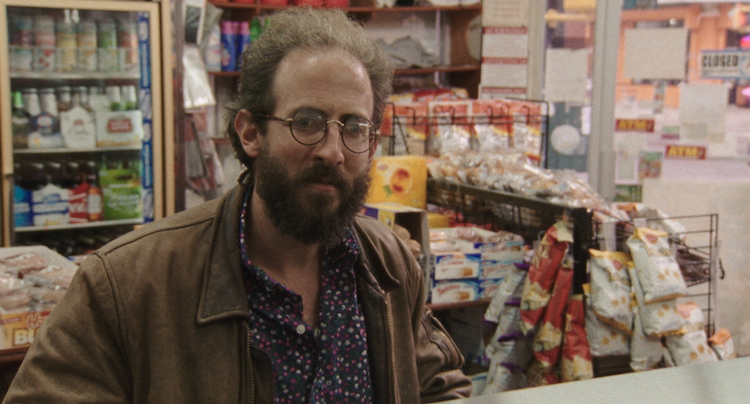
As a fan of director Dustin Guy Defa’s 2011 debut, Bad Fever, my expectations were relatively high for the filmmaker’s second feature, the delightful Person to Person. As I said in my review, Defa’s New York City collage “approaches the scope of Robert Altman and the depth of Todd Solondz.” It features some of the best performances I’ve seen this year, with the standout being Bene Coopersmith as a record collector getting close to a big score. My love for this movie was instant, and I’m sure it will stick with me for years to come.
Lady Bird
Anyone who has ever seen a Greta Gerwig performance knows that the heart of a writer-director beats within her. On screen she exudes an energy that almost shimmers; there is no ounce of her that isn’t committed the story she occupies. It is no surprise, then, that her debut directorial effort, Lady Bird, is one of the year’s great films.
And yet Lady Bird is a film that surprises nonetheless. Saoirse Ronan possesses a similar luminance to a Gerwig portrayal, controlling the screen wherever she goes while remaining aloof to the power she holds over the screen, its inhabitants and its audience. That this story is one of a woman coming to grips with the force of her own being requires such a presence. Ronan’s foil, Laurie Metcalf, wrecked me as Lady Bird’s mother, a woman discovering the exact opposite: that her power has waned enough that the she must learn to let go. Smart and affecting, funny and beautifully filmed, I hope this is a mere beginning to Gerwig’s directing days. Of course, selfishly, I hope it doesn’t keep her from stepping in front of the camera as well.
Columbus
The form of the video essay has long both attracted and repelled me. My fear with any essay is that it provides a mere surface understanding of a film, a textual analysis devoid of whatever spark of life exists between the frames. The essays by kogonada have always allayed those fears. Instead of playing mortician, his have always breathed new life into the films he picks apart. Working with the films of others, it was clear he had a voice all his own and plenty to say. Columbus, kogonada’s first feature, is a lush coming of age tale that hews closely to the style of his favorite director, Yasujirō Ozu. Yet just as kogonada’s essays bring out his voice among the pieces of others, this film is much more than a surface-level homage.
I have seen precious little Ozu, but kogonada seems to have struck upon a rather useful confluence: that American independent cinema of the last decade and a half or so share a great deal with Ozu’s most well known stories. Namely they are tales of family life told simply but unsparingly, plumbing the emotional depths of their characters while, crucially, allowing that one’s surroundings are an extension of themselves. Columbus is a film about modernist architecture, but it is also about what modernism has wrought.
Haley Lu Richardson provides the standout performance here as Casey, a young woman who is skipping college to work in a library and help keep her mother sober. The role feels impossible. She is often in total control but wants to break free of herself. She skipped over teenage angst but longs for it. The performance, and the film itself, at times feels disjointed, which is part of what draws me in further. The film sometimes becomes too clean, too perfect and manicured like the landscaping amid the primly kept buildings; it is when it flails around for its footing that it becomes something more.
Wonder Woman
Most of my favorite films this year come from the indie arthouse world. I do not know if Wonder Woman would make the cut were it not for the voluminous baggage that comes with being a DC Comics film. Almost everything I like about this film must be put in context, and I’m not sure if I will still like it in five years or even next year. But for now: it floored me.
I can boil it down to one word: empathy. I can’t recall an empathetic superhero film since, probably, Richard Donner’s Superman: The Movie. The paradigm lately has been that of the sympathetic hero (if at all). The difference is simple: we feel for the sympathetic hero while the empathetic hero feels for, well, if not us than for something.
Wonder Woman’s centerpiece moment in “No Man’s Land” works not (just) because of the music and the reveal of Diana’s costume and the significant buildup to seeing something extraordinary; it works because our hero has the revelation that people are in trouble and she can do something about it. It is a selfless, heroic act committed in a world of cynics. This empathy oozes off the screen and it is a delight to watch.
The Big Sick
There are laughs in The Big Sick that come from places I can barely understand. Even when there is nothing funny happening, the laughs keep coming. I only watched it once and it had me laughing through tears. I’ll need to revisit again soon and write proper thoughts about the way it affects me.
Porto
It was my great pleasure to see a 35mm print of Gabe Klinger’s Porto at SXSW. It is a beautiful little novella of a film, and an unintentional elegy for its star, Anton Yelchin. He plays Jake, a loner wandering the streets of Porto, Portugal who meets Mati, played by Lucie Lucas. Revisiting my notes, I scribbled that Jake almost feels like Travis Bickle; Yelchin delivers a performance on that same level.
Porto’s run time is short, a mere 76 minutes, but it is a deep meditation on the concepts of lust and love. Its narrative is expertly crafted, and it makes the pain of losing Yelchin feel all the worse. Seek it out.
Suntan
I was very happy to see Argyris Papadimitropoulos’ Suntan get a US release this year. It’s of a genre I call “fucked up Greek stuff” along the lines of Yorgos Lanthimos’ work, though on a much more accessible end of the spectrum. The film follows Kostis, a doctor with a dark past who moves to a beach town. He becomes something of an aged mascot to a youthful group, but he thinks much more of the relationships he has forged than his counterparts.
What I loved about watching this film is I never knew where it was going to take me. There is a sense of violence beneath the surface of every scene, but you are strung along always wondering what will come next. The mysteriousness does not feel like a gimmick; more like a sort of raw power that pumps the story forward. By the end you will rethink what you have been feeling throughout.
The Rest
Star Wars: The Last Jedi was enjoyable enough. I will remember it mostly for the bunk coverage of fan vs. critic reactions. Can we please once and for all never have another story based around Rotten Tomatoes or Metacritic or whatever else scores? Another highlight along this storyline: the Tomatometer killed Baywatch or something.
I loved Get Out, which may well be one of the most written about films of the year. I can’t add much to the chorus, but I will say this: it’s been a delight to see both Jordan Peele and Keegan Michael Key break into movies since the end of their Comedy Central show. Key’s acting is always a wonderful addition to anything he’s been in, particularly Don’t Think Twice. And Peele has turned out to be the voice of a new generation of filmmakers. I’m very glad he’s not sticking to fare more akin to Keanu, which he co-wrote.
James Franco’s The Disaster Artist is a fun backstage comedy. I wrote about it back in March. One thing I forgot to mention is the cameo by Judd Apatow, who plays against type as a believable asshole. Acting!
mother! is insane and nowhere near as smart as it believes itself to be, but worthwhile viewing nonetheless. It’s the sort of film that belongs, perhaps, on a midnight movie circuit. If you can stomach it, it makes great conversation fodder. I wouldn’t be surprised if I revisit it in years to come and have completely new and different feelings about it. A surprise was Kristen Wiig’s role, which manages to eek out a bit of levity amid unrelenting cacophony.
A few negative thoughts: I did not understand the love affair everyone else seemed to have with Baby Driver. The opening car chase was thrilling and then nothing after approached its inventiveness. Narratively everything starts to fall apart towards the end when our bad guy turns out to be the wrong person. (And an adversary suddenly flips for no reason?) It didn’t do much for me.
I am not a huge fan of Christopher Nolan to begin with, but Dunkirk feels sterile and stunted. In trying to tell three stories well it feels as though we don’t even have a full thread to follow. Though the photography is impressive, it doesn’t all come together for me like the Swiss watch the film’s score would have you believe you it is. For my money, the tale of Mark Rylance at sea should have been the whole film.
Blade Runner 2049 felt like two movies, one of which I really enjoyed! The other, not so much. The photography is, naturally, stellar. Roger Deakins deserves all the awards, but perhaps he’ll get skipped over as is the annual tradition.
I think that covers just about everything I have to say about the movies this year. Next year will bring a new set of stories and, hopefully, a new class of storytellers. I’m looking forward to see what the future holds.
A Comment on a Comment
It’s not a regular habit, but this morning I decided to weed out a few old passwords stored in 1Password. One in apparent need of updating was Disqus, where all the comments for the candler blog are hosted. So I logged in only to realize I hadn’t in many months. There were three unmoderated comments waiting for me. One moved me to write this.
For roughly the past year, I’ve kept comments off on new posts. My default is still to have comments on; I manually make the call on nearly every post to turn them off. The comments here have never really gotten out of hand as they do on other sites. I guess it just seemed like another thing I didn’t feel like managing.
The comment from this morning is making me rethink that call, and took me back to a different time on this site, and in my life.
About a month ago, “TimOB” left the comment on an eight year old post on the death of Steve Friedman, known to Philadelphia radio listeners as “Mr. Movie.” His comment is longer than my post by a hair, and a beautiful tribute to Friedman, Tim’s friend. I feel bad that I left his words in limbo for so long, but I’m glad I was finally able to get them online.
Discourse online has changed a great deal since 2009, when I started the candler blog and wrote the post on Friedman. Tim’s comment was a nice reminder about the value of sharing thoughts on a site like this. If I had written the same on a social site, it would have been gone within a month.
Thanks, Tim, not only for your kind words on Mr. Movie, but for helping me remember what writing online can be like. Leaving the comments open on this one.
Jonas Mekas and the Small Branches
Bilge Ebiri interviewed Jonas Mekas for the Village Voice and every word of it is wonderful. Here is his most quotable response:
I keep repeating this, but the cinema, like any other art, is like a big tree with many, many branches. Some are bigger, some are smaller, but all of them are important, and the smallest ones sometimes are more important than the big ones — because they catch the light, the sun, they feed the big lump of the tree.
I feel like this point is often lost on modern audiences. Cinema is ever changing, but the change almost never comes from the top. The wildest experiments break open our understanding of the movies, eventually bubbling up into popular art.
Here is my favorite answer, in which he returns to the theme of trees:
My films are about the present moment. You cannot film a memory. But yeah, how I film is affected by what I am made of — from the moment when I was born, I was made by every moment, every second I lived, and already even generations before were in me already. Otherwise, how would I learn to speak or anything? So, I’m like a last leaf of a big, big tree that goes, you know, centuries and centuries back. So that whatever I do and say, how I film, is affected by what I am. But what I film is now — not a second before, not a second that will come, but what is now, the present moment. And that is not memory.
At 94, Mekas is close to realizing what he calls the completion of Anthology Film Archives. Ebiri’s interview comes on the occasion of a new book, A Dance With Fred Astaire, that comes out next week. It’s a self-described “visual autobiography.” Being that Mekas has been at the center of New York film culture (and a curator of world cinema) since the 1950s, I have no doubt this will be an incredible read.
Life Imitating Art: Baseball Edition
Here’s a great little tidbit from a recent podcast with Charlie Manuel, the manager who took the Phillies all the way to a World Series championship in 2008. Back in 1993, he and yet-to-be five-time All-Star Jim Thome, were at a Cleveland Indians minor league team. As the story goes, Manuel walks into the locker room where his players are watching Barry Levinson’s The Natural.
“I saw Robert Redford standing there pointing the bat with one hand, bringing it back. I looked over at Thome, I said, ‘you can finish watching the movie. From now on that’s going to be your load.’ I took him down in the cage and worked with him. The game started and the Phillies had a left-handed pitcher named [Kyle] Abbott. He was pitching that day. I told Jimmy, ‘From now on that’s your stance.’ He gets up there the first time up, Abbott throws him a breaking ball away and he hit a home run to left center… I mean a longways. He come up the next time he hit another one to right center. I think he had three hits that day.”
”That’s a true story," Manuel added.
I love the idea of a bunch of ballplayers sitting around watching The Natural in the locker room. Crazy to think Thome would take his stance from a film, but if it works, it works.
As a side-note, I happened to rewatch The Natural last year after reading Bernard Malamud’s novel for the first time. It’s amazing how a few changes can alter the entire tone and meaning of a work. The Roy Hobbs of the novel is unrecognizable in the film, even though so much of the film pulls scenes straight out of the book.
“This Faithful Machine Remembers”
I heard a great Ian McEwan quote on The Writer’s Almanac this morning:
In the seventies I used to work in the bedroom of my flat at a little table. I worked in longhand with a fountain pen. I’d type out a draft, mark up the typescript, type it out again. Once I paid a professional to type a final draft, but I felt I was missing things I would have changed if I had done it myself. In the mid-eighties I was a grateful convert to computers. Word processing is more intimate, more like thinking itself. In retrospect, the typewriter seems a gross mechanical obstruction. I like the provisional nature of unprinted material held in the computer’s memory — like an unspoken thought. I like the way sentences or passages can be endlessly reworked, and the way this faithful machine remembers all your little jottings and messages to yourself. Until, of course, it sulks and crashes.
This is from a 2002 interview with The Paris Review (subscription required). Last year Matthew G. Kirschenbaum excerpted the quote in a blog post on the history of writers and word processors, which is a great read.
I was surprised the post doesn’t mention Douglas Adams, who famously owned the first Mac in Europe and continued writing on them up to his death.1 Luckily, Kirschenbaum wrote an entire book on writers and their machines, Track Changes: A Literary History of Word Processing. Added to the list.
My own writing workflow has been in flux for some time. I love writing on paper, but I have trouble holding on to those bits once they’re down. I’m trying my darnedest to wrangle all my thoughts and write more. Hearing how other writers work always fascinates and inspires me.
-
You’re really going to want to click that link for an incredible story about a used Mac. ↩︎
A Great AirPod Accessory for Runners
AirPod Covers with a Silly Name
For a few weeks now I’ve been enjoying Apple’s AirPods. Since the EarPods that come with iPhones have never really stayed in my ears too well, I wasn’t sure these would work for me. I’ve always preferred an earbud that goes as far into my ear canal as possible. But the allure of the AirPods won out.
They actually fit quite well in my ears and stay put for the most part. After my first attempt at running with them, though, I realized I would need something to keep them in place. Luckily, a few companies have tried to find a solution to this problem. I hopped on Amazon looking for some kind of AirPod cover to keep them in place in my ears, and I think I stumbled on the best set.
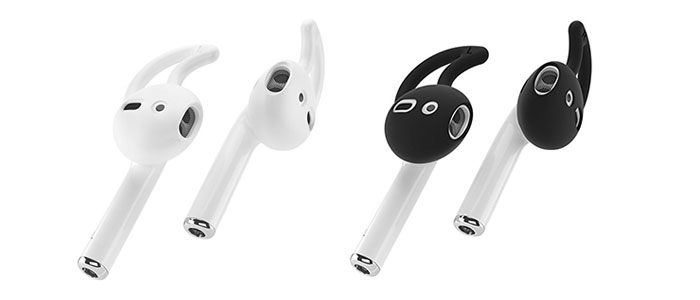
The goofily named EarBuddyz 2.0 keep my AirPods snug in my ears for an entire run. They’re little rubber (ahem, elastomer, I guess?) covers for the tips of the headphone that add a little hook that presses up into your ear lobe. Without them, I had to push the right earbud back into place every minute or so, the left one maybe every five minutes. Once I put them in, there was zero movement on them. Those things were completely snug in my head.
The best part is that the latest version of these things (2.0!) features cutouts for the little sensors on the AirPods that determine whether they’re in your ear or not. When I ordered these I figured a 50/50 chance they would actually line up, but they line up perfectly with the sensors. It takes a bit of fumbling to actually put the cover on straight. My tip is to use the front of the AirPod, where the sound comes out, as a guide. Once that’s aligned, everything else falls into place. It’s nice to have them securely in my ear without compromising on the great features of the AirPods, like automatically playing or pausing when you insert or remove an earbud.
To my ear, using one of these covers does alter the audio slightly. It’s hard to describe, but I find these cut off some of the higher frequencies, resulting in audio that’s a bit bassier than what I was listening to without them. It didn’t make anything I listened to sound bad, there’s no muffling or garbling. Honestly on some tracks I preferred the bassier sound. It’s just different. For me, it’s barely worth mentioning because the advantage of being able to take these running without worrying about them falling out is worth it.
The one major knock against these things is that there’s no great way to store them. You can’t keep them on the AirPods all the time because they don’t fit in the charging case. They come two pairs (there’s only one size) to a pack in a small envelope, so you really have to stash these somewhere good on their own. They’re practically made to get lost.
I ordered the clear ones, which are basically white but a little translucent. EarBuddyz (ugh) also come in black, if that fits your style better.
These little covers are a great addition to the AirPods, especially if you want to wear them while working out. There are plenty of other wireless headphones specifically designed for exercise, with features like ear hooks and sweat resistance built in. But the AirPods are the only wireless headphones with the integrated play/pause features and tap controls, and the charging/battery case makes for elegant storage by comparison. Plus, they’ll be getting better in iOS 11. So it’s nice be able to take them for a run and not worry they’ll fall out and go into the sewer. They’re a wireless headphone I can use for anything now.
Right now the EarBuddyz 2.0 are $10.95 on Amazon for the clear ones; the black ones are $9.95. Buying them from these links supports this site, so I thank you in advance. If you have AirPods, I can’t recommend them enough. And if you were on the fence about ordering AirPods because of the fit, know that there are solutions to keep them in your head.
Scorcese on Cinema in Context
Martin Scorsese in The Times Literary Supplement:
Every time I get back into the editing room, I feel the wonder of it. One image is joined with another image, and a third phantom event happens in the mind’s eye - perhaps an image, perhaps a thought, perhaps a sensation. Something occurs, something absolutely unique to this particular combination or collision of moving images. And if you take a frame away from one or add a couple of frames to the other, the image in the mind’s eye changes. […] This “principle”, if that’s what you could call it, is just as applicable to the juxtaposition of words in poetry or forms and colours in painting. It is, I think, fundamental to the art of cinema. This is where the act of creation meets the act of viewing and engaging, where the common life of the filmmaker and the viewer exists, in those intervals of time between the filmed images that last a fraction of a fraction of a second but that can be vast and endless. This is where a good film comes alive as something more than a succession of beautifully composed renderings of a script. This is film-making.
A rousing defense of the cinema from one of its greatest students.
Scorsese’s article is about one of cinema’s fundamental conflicts: its relationship to the other arts, namely literature. The portion I’ve quoted above, though, resonates with me because of the current climate of film appreciation online. So much digital ink is spilled over scenes and shots and spoilers and trailers and the like.These things are fun and interesting, but they are not cinema.
The “intervals of time between the filmed images that last a fraction of a fraction of a second but that can be vast and endless” is a beautiful definition of cinema. The complexities of this art form come from its inherent dichotomy, that there is craft in both instant and a span. You cannot have cinema without the frame, but the frame is not cinema.
We get so lost in the minutiae of film that it helps to step back and look at it as a whole form. Scorsese offers just that opportunity in this essay, which I’ll link again because it’s a must-read.
This Piece of Film Criticism Woke Me Up This Morning
Look, I had to wake up anyway. After snoozing my alarm a few too many times, I snatched my phone off the charger and started scrolling through Twitter. This is an unhealthy habit, scrolling through piles of hot takes on depressing news, I know, but some habits are tough to kick.
I can’t remember the tweet that led me to Bilge Ebiri’s Village Voice piece on Lynne Ramsay’s You Were Never Really Here. I don’t even know why I clicked on it. Cannes news can be a bit numbing from afar, with most articles that bubble up covering all the same festival buzz. (What got booed!? Who was chummy on the red carpet!? Almodóvar v. Smith because Netflix!) The piece even has a hallmark headline for the sort of piece I was in no mood to read: “The Best Film At Cannes Almost Didn’t Make It There On Time.”
But! I’m glad I clicked it, because reading the piece invigorated me. It reminded me that great criticism happens every day, and that I need to seek it out.
What’s so great about the article is that it is both criticism and journalism. It offers, expediently, a history of Cannes latecomer films, setting the stage for the premiere of Ramsay’s film. Ebiri then reviews the film in question on its own merits before weaving it into the context of this year’s festival, and then puts this year’s festival in a more macro context against all other Cannes. All in under 1200 words!
It’s criticism because it goes deep on the film. (“In Ramsay’s cinema, emotion is memory, and it feeds the present and the future.”) It’s journalism because it reports facts from the ground. (“We’d already heard, even before it all started, that Thierry Frémaux’s programming committee had viewed Ramsay’s You Were Never Really Here in incomplete form but had still included it in competition because they saw ‘the potential of an artist, a poet, and an author.’ All fest long, there were rumors that Jonny Greenwood was still finishing his score, that the film was due to arrive right before the premiere. Would the screening even happen?”) And it’s just plain great because of descriptions like a “95-minute nervous breakdown of a movie.”
Last week I published a piece here about regaining my enthusiam to write. Reading great writing is a solid way to get motivated. Bilge Ebiri provided that shot in the arm for me today. He cut right through my own cynicism about the sameness of so many articles that cross my path.
And now I need to see that movie, too. Added to the list.