Shimon Peres: 1923-2016
I’m sad to hear of the passing of Shimon Peres. My friend Judah Ari Gross, a journalist in Israel, put it best two weeks ago when he compared Peres to Benjamin Franklin. In Israel and abroad, that is roughly the stature Peres has been able to maintain for decades.
I had the great pleasure to meet Peres twice. I helped organize an event in college bringing him to the University of Pennsylvania. At a reception, a staff member introduced me to him. We shook hands and I said something to the effect of, “It’s a great honor to meet you.” His answer was one word: “Yes.” He wasn’t wrong.
The other time I met Peres was on a trip to Israel with organizers of similar events across the U.S. He was incredibly gracious with his time. He spent his entire adult life in Israel’s public eye, famously brokering the Oslo Accords, which remain the most ambitious, most audacious effort to bring peace to the region.
It seems like a distant memory now, after so many more years of war, but in early 1990s it felt like we were sitting on the edge of history. Peace really seemed possible thanks to Peres.
There will be many fond remembrances of Shimon Peres. Tzipi Livni wrote a beautiful piece for The New York Times. This passage sums up what set Peres apart.
We could all see it in his eyes; he wanted to be loved — but he was not willing to give up on his beliefs.
I saw it every time I watched him ignore the cynics, risk being called naïve, and continue doggedly to speak for and pursue peace. This was the lesson that every leader needs to learn: Follow your inner compass no matter what.
He will be missed.
iTunes Movie Bundles
The Social Network
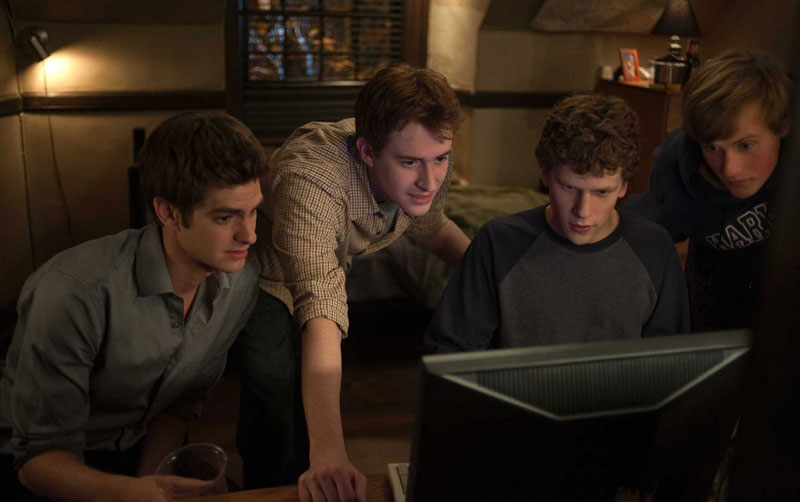
Apple is running an amazing deal today celebrating 10 years of iTunes Movies. They have 6 movie bundles, each with 10 films, for $9.99 each.
At the 2006 Apple special event where Steve Jobs introduced the feature, Movies in iTunes were a signature “One more thing…” moment, but then he outdid himself and added a “One last thing….” That last thing was the Apple TV, then an experimental device nicknamed the “iTV.” Crazy to think the Apple TV is only a year older than the iPhone. When they launched iTunes Movies they did it with only 75 movies. A lot can change in a decade.
The movies in these bundles cost between about $10 and $17 a piece, so even if you only want one film you’re walking away with a deal. The Paramount bundle, which has the most movies I’d want to watch again and again, would set you back about $150 before tax separately.
Here are the full lists. These are affiliate links, so I thank you in advance if you do any shopping. The deal is only good for today, so chop chop.
10 Years of iTunes Movies - Warner Bros.
- The Judge
- Live Die Repeat: Edge of Tomorrow
- Pacific Rim
- Magic Mike
- Contagion
- The Town (2010)
- The Hangover
- Sex and the City: The Movie
- 300
- Superman Returns
10 Years of iTunes Movies - Universal Studios
- Ride Along
- Identity Thief (Unrated)
- Rush
- Snow White & the Huntsman (Extended Edition)
- The Adjustment Bureau
- Little Fockers
- It’s Complicated
- Forgetting Sarah Marshall (Unrated)
- Knocked Up (Unrated)
- Inside Man
10 Years of iTunes Movies - Paramount
- Whiskey Tango Foxtrot
- Selma
- The Wolf of Wall Street
- Flight
- No Strings Attached
- The Fighter (2010)
- Up In the Air
- Tropic Thunder (Director’s Cut)
- The Curious Case of Benjamin Button
- Zodiac
10 Years of iTunes Movies - Sony Pictures
- The Monuments Men
- Captain Phillips
- To Rome With Love
- Moneyball
- The Social Network
- Easy A
- Julie & Julia
- Nick & Norah’s Infinite Playlist
- The Pursuit of Happyness
- The Da Vinci Code (Extended Cut)
Frankenstein, the Baroness, and the Climate Refugees of 1816 ⇒
Gillen D’Arcy Wood has an article over at The Public Domain Review that is a reminder that history and literature are not as finite they may seem. They grow and change with the times.
In Frankenstein’s Creature, Mary Shelley offers us the most powerful possible incarnation of the loathed and de-humanized refugee. The “Year Without a Summer”, with its ghost story competition by the lake, remains one of the best-loved biographical vignettes of the Romantic period. But now, as we commemorate that direful year, it is no longer the story it was.
Fantastic piece of historical journalism. Adding Wood’s Tambora: The Eruption That Changed the World to my “To Read” list.
(via Joe Dawson at Coudal.)
Mitchell’s McSorley’s in Color
Jen Carlson at Gothamist has gathered 40 color photos of New York City in the 1940s from a trove of Charles W. Cushman’s collection, digitized and maintained by Indiana University. It’s an incredible collection.
One thing about the city that’s always mystified me is how it manages to always feel like New York, even across time. The skyline and the fashions have changed, but in general it looks exactly like the place I called home for six years.
One of my favorite photos in the collection is this one of McSorley’s Old Ale House:
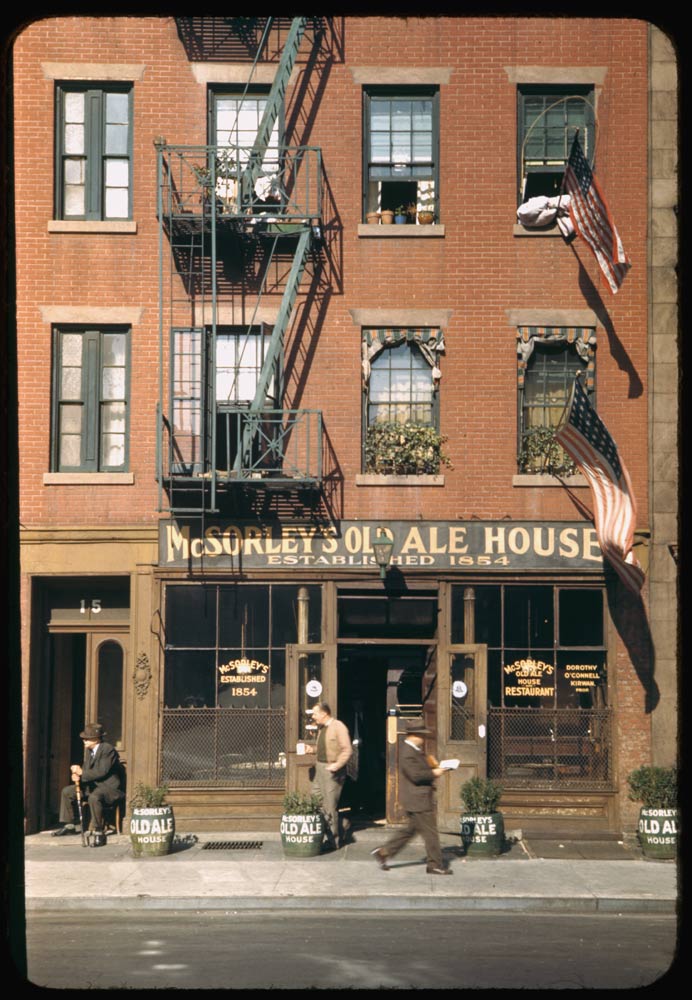
East 7th St. between 3rd and 2nd Ave. by Charles W. Cushman
I’ve mentioned McSorley’s here once before, two and a half years ago, in a story about accidentally taking Brett Terpstra and a co-worker there. In retrospect my writing is a bit embarrassing:
I took them to McSorley’s Old Ale House, something of a tourist trap with sawdust on the floor that only serves small glasses of their house beer. It was a bit of a mistake on my part but we got a round and got to talking.
Earlier this year I finally picked up Joseph Mitchell’s Up in the Old Hotel, a collection of the writer’s profiles from The New Yorker. I had been meaning to read it for years, ever since John Gruber and Glenn Fleishman discussed it on The Talk Show back in December of 2013. But I put it off. I wish I had at least looked at the cover illustration that initiated their conversation, then maybe I would have avoided calling it a tourist trap.
Mitchell’s first story in Up in the Old Hotel, “The Old House at Home,” from 1940, is one of the great pieces of New York writing. And it’s about McSorley’s Old Ale House. I’d only been the one time, but I’d love to go back again and take it in a bit more, considerings its long and storied history.
Charles W. Cushman’s photo of the McSorley’s façade is dated October 7, 1942, which means this is the era of “The Old House at Home.”
It is a drowsy place; the bartenders never make a needless move, the customers nurse their mugs of ale, and the three clocks on the walls have not been in agreement for many years. The clientele is motley. It includes mechanics from the many garages in the neighborhood, salesmen from the restaurant-supply houses on Cooper Square, truck-drivers from Wanamakers’s, internes from Bellevue, students from Cooper Union, clerks from the row of secondhand bookshops north of Astor Place, and men with tiny pensions who live in hotels on the Bowery but are above drinking in the bars on that street.
Mitchell painted an incredible picture with his pen, but it’s nice to have this kodachrome image too.
Dusty Bought This Huge House in Southampton
Hannah and Her Sisters Still
Robin Pogrebin has an interesting piece in the Art pages of The New York Times, “Can the Old Masters Be Relevant Again?” Apparently art collectors aren’t buying old paintings much anymore.
“They want to be associated with the new and the now,” said Edward Dolman, chairman and chief executive of Phillips auction house, who spent much of his career at Christie’s chasing works by old masters but now focuses on contemporary art.
“We have no intention of selling old masters pictures or 18th-, 19th-century pictures, because these markets are now so small and dwindling,” he added. “The new client base at the auction houses — and the collecting tastes of those clients — have moved away from this veneration of the past.”
To be sure, the interviews in Pogrebin’s piece ring of old versus new money classism couched in “they don’t make ’em like they used to” (with “’em” being wealthy art collectors) lamentation. Put another way, this is a problem that’s not a real problem for most.
Nonetheless, the article got me thinking whether there is a similar divide in cinema. Are audiences losing interest in the “old masters,” instead opting for “the new and the now?”
This is not an easy comparison, since films aren’t really “collected” the same way paintings are. Yes, film lovers buy Blu-rays and DVDs, but since they are rarely scarce, they can be gotten at a reasonable price. Paintings are a whole different ballgame.
I think movies may actually have the opposite problem from the art world: maybe the contemporary isn’t revered at all. New works seem to just fade away as we shore up the thrones of our old masters. Go seek out photos and anecdotes of, say, Stanley Kubrick or the original Star Wars and you’ll be lost for hours, maybe days, before running out of material online. But will what is contemporary now get such treatment in the future?
Consider, as an example, two films released in the U.S. in 2014: Jodorowsky’s Dune and The Dance of Reality. The former is a documentary covering the filmmaker Alejandro Jodorowsky’s failed attempt in the 1970s to make a film out of Frank Herbert’s Dune, the latter a contemporary film by Jodorowsky. I still haven’t seen the documentary (I have no doubt it’s good) but the latter was my favorite film that year. Somehow, the story of a film not made proved far more popular than an actual work from the same artist. An old master, as it were, was outshone by his younger.
My favorite bit in Pogrebin’s article comes from the salty sounding art dealer Christophe Van de Weghe:
“People who come into the contemporary field like colors that go well with their couches,” Mr. Van de Weghe said.
“All these new buildings — with high ceilings, big windows,” he added, “they scream for contemporary art.”
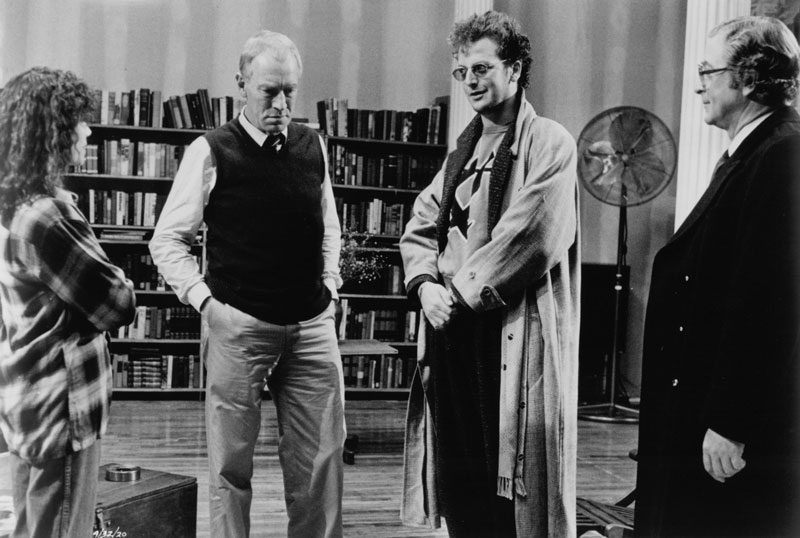
This immediately called to mind Daniel Stern’s small but memorable role in Woody Allen’s Hannah and Her Sisters. He plays Dusty Frye, a wealthy rock star decorating a new home. His accountant, Elliot (Michael Caine), sets up a meeting with his sister-in-law’s lover, the artist Frederick (Max Von Sydow).
Dusty and Frederick head to the basement to see his larger oil paintings (“Well, are…are they big? … ’Cause I got a lot of wall space there.”) and they return in a shouting match.
{::nomarkdown}
For one character, art is decoration; for the other, art is more visceral. They’re both right.
In cinema, they can both be right too. Films can be disposable entertainment and lasting masterpieces at the same time. They can “blend in with the sofa,” so to speak, and rock us to our core anyway. I just hope the films of today stick around long enough to become “old masters.”
“Why not just serve an egg?” ⇒
Fantastic piece from Nick Paumgarten in The New Yorker on Damon Baehrel, a chef in upstate New York whose restaurant is booked a decade out.
The first course was served on a slab of sawed wood. It was a small rectangle of what looked like salami atop a curled cracker. He said, “It takes me sixteen to eighteen months to make cedar flour. I use a pull knife, a two-handled grater, to shave off some cedar under the bark. The shavings are bitter, tannic—inedible. I soak them in water. Every four to six weeks, I soak them. After a year or a year and a half, I can grind it into cedar flour. So the crisp is made from cedar flour, with a little hickory-nut oil, duck-egg-white powder, water, sea salt, which I sometimes render.”
There’s more to the story than just food though. Keep reading.
When I described the situation to a friend of mine, he suggested a “stakeout.” But that seemed crazy. Doughnuts and coffee? Full camo? This wasn’t a crime story.
Paumgarten definitely should have gone on a stakeout.
Elegy for Vesper
Vesper
Vesper wasn’t an app for everyone. A lot of people thought it was under-featured and overpriced from the get-go. Maybe it was too simple. Another word is elegant. Now it’s shutting down.
Vesper was a notes app for iPhone (and later iPad) by John Gruber, Brent Simmons and Dave Wiskus. It didn’t have the stuff a lot of other text editing apps had. No extra row of keys. No Markdown syntax highlighting or auto-completions. No fancy export workflows or publishing tools or anything like that. Not even Dropbox sync; no sync at all at launch.
But Vesper was innovative in two key ways: tags and photos. No note taking app before or since has treated photos as well. And I can find no replacement for the way it handled tags.
One of my biggest uses for Vesper over the years was to pull interesting quotes out of print books. I would open Vesper up and snap a photo of the page. Sometimes I added text to the note with the title and page number. Sometimes I dictated the specific quote. Later on I would use apps like TextGrabber or PDFPen Scan+ to OCR the main quote I wanted, but I still liked having the photo of the page. It added some context for the quote that caught my eye. I’d add some tags, like “books” or “quotes” or both. And then I’d get back to reading.
The brilliance of Vesper’s photo handling was that it didn’t treat photos as inline elements. They were almost like metadata, an aspect of your note. The photo itself could be the whole note.
When Apple added photos to Notes last year, many said it was the death knell for Vesper. But Notes treats photos differently. They are inline, part of the note. They are not the note itself. For me that’s not as attractive. It adds complexity where I’d rather have none.
Vesper didn’t invent tags, but their implementation is the best I’ve ever used. It’s so simple and effective. At the bottom of a note, you can add tags. Start typing and previously used tags appear, ready to be tapped and added. To the left of the editor and timeline is your tag browser. All your tags, organized alphabetically. I had tags for Recipes and Beer, Quotes and Cinema and a few others. I tried to keep them sparing, but wasn’t afraid to add a new one as necessary. It was an easy way to recall notes I’d taken on any topic.
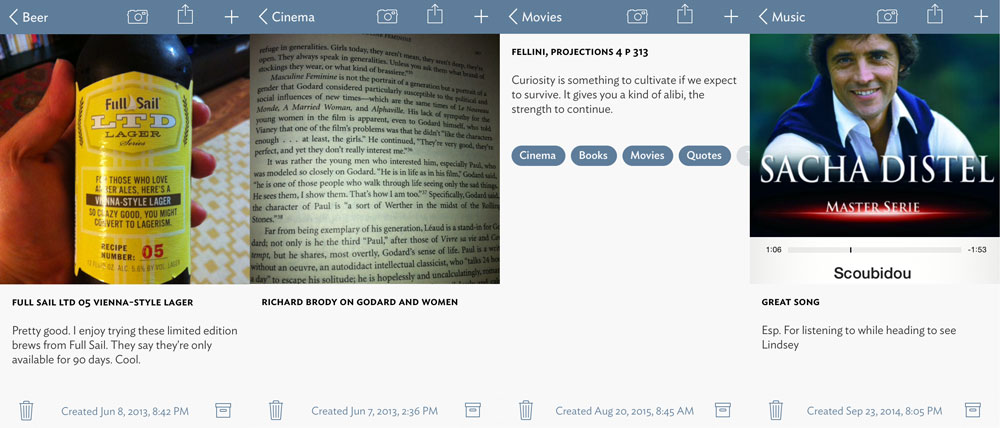
Notes in Vesper
I tried, in vain, to adapt the tagging system to Apple Notes, which uses folders. Tags and folders seem similar, but of course they’re not. Outside of Vesper I’ve never used a tagging system that stuck. I find they only work when you have a clear limit, like, say, one set of tags for a single type of file. Like a bunch of notes. That’s why I’ve never made much use of tags in Finder. Vesper made it easy to limit tags, thus making them that much more useful for me.
For a long time Vesper was the only notes app on my home screen. All sorts of thoughts and ramblings and dreams went in there. There’s one note I’ll never forget.
Two years ago, I met a girl on the Internet. We chatted for weeks but we couldn’t meet in public because she had broken her leg in three places as well as her hand. She was holed up at home, could I wait until she could at least walk with crutches to meet? Probably, I said.
When we discovered we had a mutual friend, someone I had worked with in New York who turned out to be someone very close to her since grade school, she warmed to the idea that I could visit. The friend vouched that I wasn’t an axe murderer, so I was invited over for dinner. She wanted sandwiches, so I jotted down her order to make sure I didn’t mess it up. I wrote it in Vesper.
We’re getting married in March.
Software can be very emotional. That’s why there’s so much of it. I still remember clacking away on my parents’ PC’s Limited as a kid, playacting Doogie Howser in the blue expanse of WordPerfect. Those words have all been lost, but the memory of the application remains.
I connected on an emotional level with Vesper. Maybe it was the color scheme or the typography. I don’t know. It provided an environment I wanted write in. And I knew that anything I put in it would stay there, ready for quick recall.
If there were no Vesper would I have gotten the sandwich order right and met the woman I would marry? Of course. But there was a Vesper.
Frank Ocean’s 100 Favorite Films
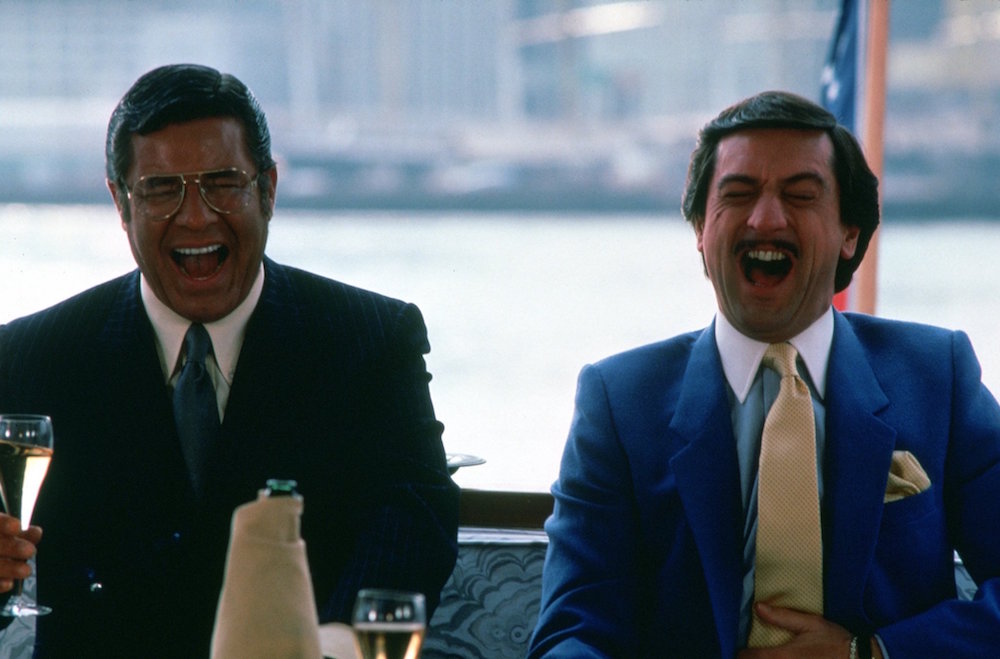
This weekend, Frank Ocean released his long awaited album, Blonde. I’ve been enjoying it. I wish I could’ve gotten my hands on his short run magazine, “Boys Don’t Cry,” but none came to Austin (if you’ve got one you can part with, get in touch).
At least people are posting all the goodies on the web. My new favorite: Ocean’s list of favorite films. In no particular order (that I can make out), here are 100 of his favorite movies. (All notes are Ocean’s.)
{::nomarkdown}
- ATL (ATL is not the best movie lol but ok)
- Un Chien Andalou
- Blue Velvet
- Barry Lyndon
- Battleship Potemkin
- Eraserhead
- Chungking Express
- Raging Bull
- The Conformist
- The Bicycle Thief
- Taxi Driver
- A Clockwork Orange
- Mean Streets
- Gods Of The Plague
- Persona
- Mulholland Dr
- Happy Together (Wong Kar Wai)
- Fallen Angels
- Apocalypse Now
- The Last Laugh
- Pi
- Full Metal Jacket
- No Country For Old Men
- Wild At Heart
- Memento
- Metropolis
- Rushmore
- The Royal Tenenbaums
- Miller’s Crossing
- The Discreet Charm Of The Bourgeoisie (Luis Buñuel)
- Blood Simple
- Rashomon
- Orpheus
- LA Confidential
- Reservoir Dogs
- Eastern Promises
- 2001: A Space Odyssey
- Battle Royale
- The Passion Of Anna
- Bring Me The Head Of Alfredo Garcia
- Oldboy (Park Chan-wook 2013)
- Django Unchained
- One Flew Over The Cuckoo’s Nest
- The Good, The Bad And The Ugly
- The Godfather
- M (Fritz Lang)
- Scarface (Howard Hawks 1932)
- Scarface (de Palma 1983)
- Blade Runner
- Citizen Kane
- On The Waterfront
- Annie Hall
- Psycho
- Dr. Strangelove
- The French Connection
- The Deer Hunter
- Wild Strawberries (Bergman)
- Fargo
- The Sacrifice (Andrei Tarkovsky)
- El Topo
- The Holy Mountain
- The Shining
- Pulp Fiction
- Fitzcarraldo
- American Beauty
- Solaris (Andrei Tarkovsky)
- True Romance
- Elephant Man
- Seven Samurai
- Woyzeck
- Jackie Brown
- Aguirre, The Wrath Of God
- Paris, Texas
- Devil In A Blue Dress
- Inglorious Bastards
- Serpico
- Alien
- Ed Wood
- Hard Eight
- The Seventh Seal
- Sonatine
- Paths of Glory
- There Will Be Blood
- Spartacus
- Assassination of Jesse James By The Coward Robert Ford
- Fight Club
- Brazil
- Throne Of Blood (Akira Kurosawa)
- The Master
- Dog Day Afternoon
- Rosemary’s Baby
- Phantom of the Paradise
- Inauguration of the Pleasure Dome
- Malcolm X
- Scorpio Rising
- The Friends of Eddie Coyle
- Puce Moment
- Nosferatu (F.W. Murnau 1929)
- Basquiat
- The King of Comedy
[Ed. note: I capitalized the titles. Ocean lists “Inglorious Bastards” without a note. This could refer to the 1978 Enzo G. Castellari film, or it could (more than likely) refer to the Quentin Tarantino film, which is spelled “Inglourious Basterds.” I left the original spelling.]
Ocean’s list is one of the best of these sorts of things I’ve seen. It’s eclectic and comprehensive. There are short films, foreign films, old films, weird films, popular films…like I said, comprehensive. It’s anything but pretentious. I’ve only seen 65 of the films on the list, and would love to fill in my gaps. I would say anyone looking to get into cinema would do well to pick a few off this list and check them out.
I love when artists do things like this, especially when it’s for a different discipline. The worlds of film and music are not without their crossovers, but they certainly have their own die-hard communities. This is a great way to bring more people into the cinema fold.
Speaking of, Ocean also shared his favorite songs, which Dean Gouskos made into a Spotify playlist. I’ll have to give those a listen.
(via Vulture.)
UPDATE: I made a page for this list over on Letterboxd. What’s nice about that is that you can quickly check off which films you’ve seen. Even better, you can filter the list by streaming service. So you can quickly file down and see what’s on Netflix, Hulu, Amazon Prime and a host of other sites. This works reasonably well in the US. I have no clue how well it works (if at all) in other countries. Some are even available on YouTube (for now), like Kenneth Anger’s films Puce Moment and Inauguration of the Pleasure Dome.
Double Feature: Persona & Blow-Up
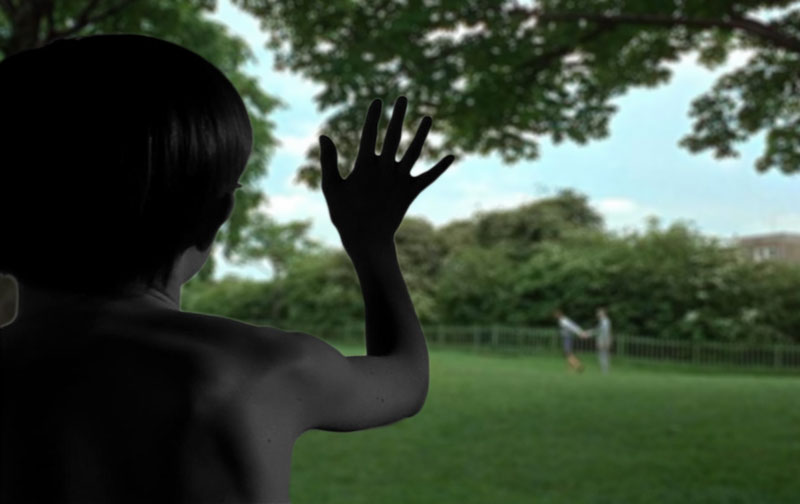
Persona and Blow-Up
Last night I caught a double feature at the Paramount Theater here in Austin. A 35mm print of Ingmar Bergman’s Persona followed by a beautiful DCP of Michelangelo Antonioni’s Blow-Up. Both films had somehow eluded me all these years, so it was nice to see them with a crowd on the big screen.
I sat way up close for Persona. As film prints become rarer to come by, I like to get my face close up to them and take in every detail they have to offer. Also, when a film is not widescreen, the imposing vertical space of the screen can best be experienced in the front few rows (for me, at least).
I was happy that the Paramount eschewed any form of introduction for the Bergman film. For those who haven’t been, it’s an old-school movie palace in the heart of downtown. For most of the year it’s a live music/event venue, but all summer long they run classic films. Since it’s not a movie theater first and foremost, there are no previews, no “Be quiet and please visit the concession stand” bumper to start things off.
Usually there is a curator of some sort to come out and tell you a bit about the film. Not last night, though. Instead the lights went down, the projector started, the massive red curtain opened up and suddenly we were in Bergman’s world. This, I think, made for the perfect first viewing of Persona, especially since the film’s end is an exact reverse of of its opening. In this case, that included the red curtains shutting as the projector went off.
The film is a puzzle whose pieces get increasingly more complex as time passes. Once you think you have a handle on things, another shocking revelation will come to you. Its most audacious conceit is that you, the viewer, are very much watching a film. Perhaps a film within a film, or maybe some meta-film in which you are a participant. I have trouble believing that any two people in the theater last night had the same experience. It’s a deeply personal experience.
For the purposes of my writing here, the plot of the film is irrelevant. You can find essays and descriptions and reviews elsewhere. After I publish this I plan to read Thomas Elsaessar’s essay on the Criterion website, and I will watch Richard Brody’s “DVD of the Week” video. I’d rather not cloud my own thoughts in the meantime.
Sven Nykvist’s black-and-white photography looks gorgeous on 35mm. The gradations he is able to pull out of a scene are astonishing. Together, Bergman and Nykvist make up one of the great filmmaking teams. The resulting images, the signature closeups and characters whose faces bisect one another, either through trick photography or, more often, clever blocking with exacting focus, are astounding to behold on the big screen.
I’ve only seen a few of Bergman’s films.1 Each one, though, always has a profound impact on me. Persona is no different. As I’m guessing it has for countless viewers before me, it has thrown into question my beliefs of what the cinema is capable of. There are psychological depths that remain to be plumbed by this incredible art form. In 1966, Bergman brought various styles together to show us just some of what film is capable of.
Anotnioni’s Blow-Up is also from 1966, and though superficially these films seem starkly different, they made for a nice back-to-back pairing. Colorful, modish and in English, the film starts off feeling like Hollywood, but obviously not. Something is off, and over time the film asks us to delve deeper into our own psyches. Like Persona it possesses a meta-narrative, one that asks each of us to consider and re-consider: what are we watching?
I moved my seat further back in the theater for Blow-Up. I try to avoid DCP screenings as they tend to, still, look like video to me. If I’m going to see one, I’d rather move back so the image can hold together better. Up close I start to see the pixels. To my great surprise and delight, the DCP I saw last night was gorgeous. I could tell it wasn’t film, but most scenes were extremely convincing. Nice to see that so much of the original grain and movement has been retained. DCP bitrates must have gotten better since the last repertory screening I went to.2
Blow-Up is a film about the narrative process. Do we even know what reality is? What we see? What we don’t? Can we trust our own memories to be honest with us? Does memory change? I’m glad I finally saw this one, which I’ve been meaning to see forever. A lot to unpack in it, all while being a stylish ride. It feels almost like two separate films, one about the indulgences of a playboy photographer and another that explores the existential, philosophical questions mentioned above.
Of course, the appeal is that it is not two films. Antonioni manages to bring all the strands together into one cohesive whole. We can have a film that feels both weighty and disposable at the same time.
-
Perusing his ouvre, I know I’ve seen at least Wild Strawberries, The Touch (I interviewed star Elliot Gould when it screened in NYC back in 2011), Cries and Whispers, and Autumn Sonata. ↩︎
-
I’m pretty sure the last one was this double feature of The 400 Blows and Jules and Jim way back in 2009. ↩︎
Ten Years Without Mike
Today is the tenth anniversary of the death of my friend, Michael Levin. Looking through my archives, it seems the last time I wrote about him was one year after his passing. This morning I revisited that post as well as my notebooks from 2006. So many details I’d forgotten came rushing back, so many memories have been restored. I wanted to share some thoughts on Mike and the last decade.
***
Ten years ago I was relaxing at a coffee shop in Milford, Pennsylvania when I saw the message on my phone. I was teaching film at a Jewish summer camp up the road and went into town to relax a bit.
I missed two calls from my dad. He left a message that gave up nothing, but I knew it would be bad news. I called him back when I heard the message.
“Hi, Jonathan. Look…are you sitting down?”
“No, just talk.” I was pacing in the coffee shop parking lot.
“Mike Levin was killed in Lebanon today.”
“I knew it.”
“How? Did someone already tell you?”
No one told me. I just knew. What other bad news could there have been?
That summer, the Second Lebanon War had been raging. A large portion of the staff at the camp I worked at was Israeli, spending the summer abroad teaching others about their home, its language and traditions. When war broke out, everyone was looking for information, waiting to hear the status of friends and relatives back home. Some didn’t know if they would be called up, cutting the summer short to go defend their country. You got the sense all of them wanted to. It was too much to be away from home during a war.
So the war was on my mind every day. As was Mike, who cut his leave short to go back and be with his unit. When my dad called it was the only conclusion I could draw.
***
After his funeral in Israel, there was a memorial service in our hometown. Friends had come from all over the country, and from Israel too, to mourn. Local strangers came out to pay their respects.
I sat with friends from the high school program in Israel I went on with Mike. Speaker after speaker shared fond memories of him. We cried. We laughed. We embraced. We remembered.
It’s strange, watching your friend become a hero. He was already a hero to a lot of us, but now the world got to know his story. Mike’s death was front-page news. A narrative sprung up around him. He was a hometown hero, a Philly boy who made the ultimate sacrifice for his people. His is a story of selflessness and courage and bravery. It has had meaning for so many people. They learn about him and visit his grave; they follow in his footsteps and move to Israel and serve in the army.
That night, at the memorial service, Mike’s memory was only beginning to do its work in the world. And when you hear so many people praise his life and his sacrifice, it’s easy to get caught up in the moment.
I ran into our Hebrew school teacher after the service. We shook hands or hugged, I don’t remember. He told me Mike was an incredible person and he’s sorry he’s gone.
I said something to the effect of “At least Mike led an incredible life. He did everything he wanted to do. How many of us can say that?” My teacher looked at me in a way I didn’t understand at the time. He had a sadness in his eyes, not just for Mike, but for me.
What I’ve come to realize is that he was looking at me with the weight of experience, with a knowing that comes with age. I, at all of twenty-one, didn’t get it yet. Mike may have fulfilled the dreams he had, but he missed out on all the dreams yet to come.
Now I understand. Mike has missed so much, a thousand little victories, probably more. Births. Celebrations. Friendships. There is so much that makes up a life, and so much more that becomes important as you grow older.
It’s been ten years since Mike passed and I miss him all the time. I wish the world could have his smile back, his unrelenting positivity. But more than anything I wish Mike could have seen the last decade for himself. I wish he could know the beauty of growing older, meeting new people and building a life. You know, the boring stuff. The everyday.
Wherever you are, Mike, I miss you.
My heart goes out to the entire Levin family, Harriet and Mark and Elisa and Dara, and all the husbands and kids and cousins and friends and everyone else. I wish I kept in better touch, but know that you’re on my mind. I can’t believe Mike has been gone this long. May his memory continue to be a blessing.