No More Arrested Development After Season 4 ⇒
Greg Bensinger reporting for The Wall Street Journal:
At an investor conference Monday, Chief Executive Reed Hastings said the show would be a “one-off” and “non-repeatable” event for the Los Gatos, Calif., company.
It hasn’t even “aired” yet.
Some questions come to mind: How the hell does Netflix measure success? Or does it just not care? Would another network have killed the prospect of another season before releasing a single episode?
The bigger question, I think, is whether or not Netflix actually has the power to negotiate keeping a show as ambitious and sprawling as Arrested Development in production. Some of the biggest players are movie stars now; do they really want to keep on making a direct-to-video sitcom?1
I’m getting the feeling 2013’s original content rollout from Netflix is less “the future” and more, in the words of Hastings, a “one-off.”
-
What would you call it? ↩︎
Richard Brody on MacFarlane's Oscars ⇒
Richard Brody on his Front Row blog:
In the midst of the year-end Oscar-season hype, anticipating the new set of awards even more than looking back at the last one, I kvetched that the least important event was “the Oscars, which function in a giddy parallel fantasy world of cinematic values.” I didn’t suspect how right this hyperbole would prove.
As ever, his insight is excellent. I was planning to put together some thoughts on what I thought was an abysmal bit of live television, but Brody took care of the major points.
CriticMarkup ⇒
CriticMarkup, or CM for short, is a new plain text editing syntax from Gabe Weatherhead and Erik Hess. It’s a pretty darn neat way to go about editing a plain text document…any plain text document.
Could be useful for collaborating on Fountain screenplays as well.
I’m working on some new toys for using CriticMarkup now. {~~Stay tuned~>Come back soon~~}.
HBO GO to Apple TV is Go ⇒
Ina Fried reports for All Things D that HBO’s Eric Kessler just announced HBO GO streaming to Apple TV:
Speaking at our D: Dive Into Media conference on Tuesday, HBO’s Eric Kessler said, “effective today, we will be enabling AirPlay” for HBO Go.
The feature is being added today as an update to the HBO Go iOS app and for Cinemax’s MAX GO App.
Coming to Apple TV as an app eventually as well. I think I need to wait until they release another Apple TV, but otherwise I’m sold. Bye bye, Roku.
Copy-editing note: It’s still spelled HBO GO. I don’t understand how All Things D managed to get MAX GO right when MAX isn’t even an initialism but an abbreviation (of a portmanteau, mind you). Look at the text on the HBO GO iOS icon; look at all the copy on the company’s site. It’s GO, not Go.
Melton Barker Was Either a Filmmaker or a Con-Artist or Both ⇒
Amanda Petrusich at the New York Times shares the tale of Melton Barker, a traveling filmmaker who wandered the U.S. for forty years making the same film with kids in different towns…for a fee.
These days Barker’s racket might seem archaic (anyone with a laptop and a camera can get on YouTube in minutes), but let us not forget Rebecca Black, the then-13-year-old aspiring pop star whose mother paid $4,000 to Ark Music Factory, a songwriting and video production company, to create a clip for “Friday,” one of the most inescapable (and mocked) memes of 2011.
The illusion of fame has always been a hot commodity.
You can view Barker’s films (or film, rather) here, but the site is pretty sluggish today.
(via Boing Boing.)
Happy Birthday, Fountain
One year ago today, Fountain, the plain text screenwriting syntax, was first introduced to the world. What a year.
Stu Maschwitz kicked things off back in the summer of 2011. I edged my way in with this tweet:
I'm ready to try to make this work. @5tu & @ttscoff Can we get Marked to process Screenplay Markdown via ScreenPlain? github.com/vilcans/screen…
— Jonathan Poritsky (@poritsky) November 5, 2011
That was how I introduced myself to Brett Terpstra and Stu. At the time, it felt like one of those things that would float out into the ether and disappear. Only Brett and Stu were paying attention.
Before I knew it I was in contact with Stu, Brett and Martin Vilcans, who wrote the excellent Screenplain. Brett got Screenplain working with Marked and I dove into my Cole & Haag manual to find decent measurements for the CSS.
The months of emails back and forth were inventive and thoughtful. This small little group (it kept growing) of folks from around the world were collaborating to build a rock solid syntax that, if you ask me, revolutionizes the way screenwriters write.
Last January Stu sent out an email with a nice little surprise: John August would be contributing to the syntax and the project would now be called Fountain. Then, on February 8th, 2012, the Fountain site went live, I updated the Marked package, everyone wrote an introduction and this scrappy syntax started getting the attention it deserved. John Gruber even gave it a nod.
Fountain is constantly growing. Phenomenal discussions take place on the Glassboard, apps are adding support all the time and more writers are adopting it (ahem, David Wain).
Highland is still in beta but available; it’s an amazing tool that makes writing with Fountain a reality for professional screenwriters. Fountain for Sublime Text will see some updates soon and I hope to revisit Fountain for Marked eventually. One thing I’d like to see in the coming year is more tools and workflows for collaborative writing (I’ve got some ideas on that note).
I’m privy to a few other surprises coming down the pipe for Fountain’s second year, but I don’t want to spoil anything. Suffice it to say: big things await.
So happy birthday to the best damn screenwriting syntax on Earth. Keep writing.
Austin's Traffic is Uniquely Terrible ⇒
Ginger Goodin, of the Texas A&M Transportation Institute, in a Q&A at Texas Monthly:
In Austin, by contrast, we have a core area around downtown—[The University of Texas], the Capitol—where 18 percent of the jobs are located. That’s the fourth-highest percentage in the country, behind New York, Washington, D.C., and New Orleans.
Traffic is unpredictable in this town. It’s like a new adventure when I hit the road each morning.
Final Body of the D16 Digital Bolex ⇒
This body may look similar to the one we had designed in March, but really it’s a completely new camera.
That’s a good looking digital motion picture camera.

Digital Bolex
Further Reading:
- I interviewed Joe and his partner Elle Schneider last July. They’ve had some setbacks since but it’s nice to see the camera is progressing and nearly complete.
Duncan Jones Tweets Details of Source Code
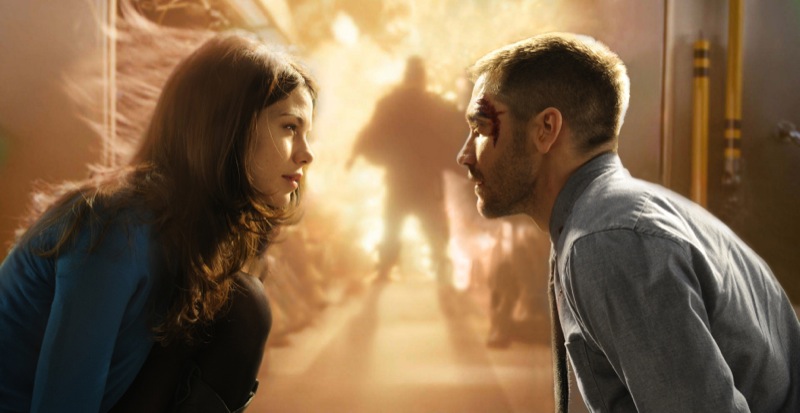
Source Code Still
Yesterday, director Duncan Jones live-tweeted his most recent film, Source Code1, as it played on BBC’s Channel 4 in the UK. He answered viewer questions, divulged some of his technique and pointed to the true story one of the film’s characters is based on.
The whole stream is a fun (and spoiler-ridden) read. I’ve collected the whole thing in a Storify stream, but below you can find a selection of my favorite tidbits. Perhaps worth bookmarking for the next time you watch the film.
On Plato:
Question if Plato's cave was an influence... not specifically, though I was a big Plato lover growing up... subliminal maybe. #SCch4
— Duncan Jones (@ManMadeMoon) February 3, 2013
On Sam Beckett’s cameo:
Being asked if Quantum Leap was an inspiration... All I can say is wait to hear Colters dad on the phone.;)#SCch4
— Duncan Jones (@ManMadeMoon) February 3, 2013
Scott Bakula plays the voice of Colter’s father.
Quan-Tomb:
Theres a lovely hidden clue in the set where Vera is that unfotunately never made the cut.The computer nearby has a title on it... #SCch4
— Duncan Jones (@ManMadeMoon) February 3, 2013
"Quan-Tomb" is the name of the large computer array to Vera's left, running the SC program.Written in big letters, but off camera! #SCch4
— Duncan Jones (@ManMadeMoon) February 3, 2013
On the 8-minute time limit:
Asked why 8 minutes?Well, need to keep the time frame short enough that there is urgency, but long enough to get something done!#SCch4
— Duncan Jones (@ManMadeMoon) February 3, 2013
On Jeffrey Wright’s exposition:
Producers understandably wanted to make sure audience was clear on SC tech... problem is, what Rutledge says is empirically WRONG! #Scch4
— Duncan Jones (@ManMadeMoon) February 3, 2013
On product placement:
Asked who actually uses Bing.......... people who want money to make their movie look better use Bing. ;) #SCch4
— Duncan Jones (@ManMadeMoon) February 3, 2013
On set design:
Pod just stretched again!Now its in "medieval prison cell mode" as we called it.Little light in the top like an old Flynn movie #Scch4
— Duncan Jones (@ManMadeMoon) February 3, 2013
On making a fake train station and van:
Story time.. HUGE mistake in production coming up.. We lost our location for the train station.Was going to use a real one #SCch4
— Duncan Jones (@ManMadeMoon) February 3, 2013
but place changed terms at the last minute so we had to come up with an alt.. ended up BUILDING a train platoform in a parking lot #SCch4
— Duncan Jones (@ManMadeMoon) February 3, 2013
cause everything was so last minute, didnt get inside of the van sorted out in time for the shoot!All that crap in the van?VFX! #SCch4
— Duncan Jones (@ManMadeMoon) February 3, 2013
stars and stripes box was real... thats it. #SCch4
— Duncan Jones (@ManMadeMoon) February 3, 2013
On that villain:
Asked what the inspiration for the villain was.... a doc called "The radioactive boyscout"Check it out.Bizarre and terrifying. #SCch4
— Duncan Jones (@ManMadeMoon) February 3, 2013
The Radioactive Boy Scout2 is actually the name of a book by Ken Silverstein expanded from this 1998 article in Harper’s. It tells the story of David Hahn, an American Boy Scout who nearly build a homemade nuclear reactor when he was 17. The Nuclear Boy Scout is the TV documentary Jones is referring to. It aired on BBC’s Channel 4 in 2003 but is yet to air in the US.
That ain’t bullet time at the end:
The freeze was GREAT fun!:)A little post touching up, but mainly just actors staying still while camera tracked back!#sourcecode
— Duncan Jones (@ManMadeMoon) February 3, 2013
Further Reading:
- I reviewed Source Code when it premiered at SXSW in 2011 and interviewed Jack Gyllenhaal about the role.
- Probably my favorite Source Code-related out there is Eric Kohn’s physicist father explaining that science in the film basically checks out.
- Bookmark the full Storify stream if you want to time-shift Jones’ commentary.
Le Hashtag ⇒
In French at least, the hashtag is no more: make way for the officially sanctioned mot-dièse, or ‘sharp word’.
And they call a Facebook Poke a “Finger-bop with cheese.”1
-
Sorry. ↩︎