Kubrick // One-Point Perspective ⇒
Excellent new supercut from kogonada:
Kubrick // One-Point Perspective from kogonada on Vimeo.
You won’t find a better supercut artist online. Check out the others in the collection.
(via coudal.)
The Tired Case Against Apple ⇒
Another greatest hit from Apple troll bag: Apple is a technology poser that merely dresses up in pretty “marketing” the engineering innovations of other “real” technology companies.
For some, Apple is always doomed. In the old days, because they were too small, dwarfed by Microsoft. Then, a decade ago, it was because the iPod boom would surely prove fleeting and soon go bust. Now, it’s because they’re too big, doomed by their success and the company’s institutional hubris.
Gruber at his most Gruber. Love it.
Criterion Releasing Godfrey Reggio's Qatsi Trilogy? ⇒
Nice deduction from Moisés Chiullan over at Arthouse Cowboy:
Today’s Criterion newsletter “wacky drawing” contains three “caught C’s”. It’s been rumored for some time that they would release Godfrey Reggio’s three “Qatsi” movies (Koyaanisqatsi, Powwaqqatsi, and Naqoyqatsi), which have no conventional plot, and instead feature gorgeous photography centered around broad themes.
Unconfirmed, of course, but sounds solid to me.
Related: Watch Koyaanisqatsi in 5 Minutes
Final Draft Writer for iPad ⇒
Final Draft just released Final Draft Writer, a full-fledged screenwriting word processor for the iPad. Michael Grothaus writes for TUAW:
Final Draft Writer isn’t going to replace Final Draft for OS X, just like no word processor for iOS will ever replace desktop word processors for professional writers that deal with manuscripts that are hundreds of pages long. But what Final Draft Writer does do is give screenwriters the ability to work on their scripts any time and any where that they are away from their computers.
I’m sure if I had the gumption I could reach my hand into the Internet and pull up a few “professional writers that deal with manuscripts that are hundreds of pages long” who have moved to an all (or mostly) iOS workflow, but I’ll spare you.
Final Draft Writer is on sale for $29.99 until September 30th, so you should probably go get it1 before then.
I’m surprised by the price. Even at $49.99, seems low by Final Draft’s standards which worries me. Do they view this only as a “mobile” solution, not a burgeoning computing market? In other words, is the “it isn’t going to replace Final Draft for OS X” just Grothaus shooting from the hip, or is it the way Final Draft wants public perception of the app? I write on my iPad all the time, I don’t even think about it as a stop-gap anymore; it’s just another computer. Apps that fall short of accepting that credo tend to be ones that have little value for me.
That said, Final Draft Writer looks like it has potential to be a great collaboration and annotation tool for the industry standard FDX format. Like most things Final Draft, I’ll bet it becomes a great producers tool, with popularity among writers coming second. I haven’t downloaded it yet and I doubt I will. If I need to do any screenwriting on the go I use Fountain, which has a growing list of supported apps last time I checked.
-
Affiliate link. ↩︎
Netflix Could Change Everything, Alright

Arrested Development Wink-Wink
Yesterday I complained about a GigaOM article that had no meat to its “Why Arrested Development on Netflix could change everything” headline. Here’s what I think it was lacking.
Back in February, Fast Company’s Co.Create interviewed Ted Sarandos, Netflix’s chief content officer.1 He had this to say about the company’s distribution method of dropping an entire season of a series at once:
What’s unique about this initiative is we’re not really wrapped up in having a big opening and a big debut in terms of ratings. It’s not differentially important to me that anyone watches this show at any certain time. People will be discovering this show for the first time over the next several years, the same way they’re discovering Mad Men for the first time on Netflix today. But I want to try to stay out of the business of trying to influence America to do the same thing at the same time, which is a really expensive proposition.
Fair enough. That is unique and more in line with the way people binge on television in 2012. However, in introducing the interview, Co.Create sneaks in this little-discussed detail (emphasis mine):
…As the 15-year-old company gradually phases out its original means of distribution (Lilyhammer and House of Cards will not be available on DVD) it’s going to flex a muscle the other services don’t even have: With years of rentals and ratings, Netflix knows its audience’s taste inside and out and has built credibility at recommending new shows and movies.
The only way to get these original series is through Netflix’s Watch Instantly, not through the company’s disc-by-mail service. It’s still unclear whether or not these shows will ever be available on disc anywhere, or even available for purchase. Which likely means the only way to access them a year, two years, ten years down the line will be to keep paying for Netflix. Think $70 for a Blu-ray season of a series is pricy? Try $8 a month indefinitely.
Netflix appears to be playing a long game here. Tired of being jerked around by studios and networks, Sarandos and CEO Reed Hastings are building up an armory of original content that will help them weather any stormy negotiation. It’s incredibly bold and forward thinking, far ahead of what anyone else is up to.
Now, I don’t know whether Netflix will choose to sell discs for any of their original series. I do know, however, that DVD is a competing format to streaming, and Netflix is in no position to squander their format exclusivity.
The loser in all of this will be the consumer. When you buy a disc, you own it. Sure, movie studios will contest that claim, but at the very least you can put it on your shelf and watch it whenever you want, wherever you are. All you need is a player, a screen and a little bit of power. With streaming, of course, you need a player, a screen, a (decent) Internet connection and, usually, a WiFi router. If we hand over how we consume movies and TV shows to Netflix and tell them to hold onto our content, we will allow them to fundamentally change the home video game.
That may be fine. You may love Netflix. Hell, I do. But what happens when I fall out of love, or when they hike prices again? What happens when the company starts developing films and keeps them exclusive to streaming as well? And what if they fail and fall into obscurity? If released on disc, they could at the very least be preserved by fans and collectors.
I have no doubt that Netflix’s original content initiative will be a huge success, especially with popular buys like Arrested Development. What worries me is that by the time we realize what we are giving up it will be too late. We’ll have crossed the bridge to streaming distribution just in time for Netflix to blow it up.
So yes, the show’s bow next Spring could change everything. I’m just not so sure we should be so blindly revelatory of that fact.
-
I apoligize but the byline seems to be missing, so I can’t credit the writer. ↩︎
Ads Update and a Change
Almost exactly seven months ago, I announced the addition of ads to the candler blog. InfluAds has been an excellent partner. I have always been impressed with the simplicity of the ads they book. In most cases, they are from companies I either use, like or want to learn more about. Nothing about my relationship with InfluAds is being altered.
I do have another big change to announce, however. The candler blog will now feature weekly sponsorships. You may have seen similar setups on other sites,1 but let me explain how it’s going to work here:
- At the beginning of the week, I will publish a sponsored post.2
- Near the end of the week I will publish a sponsored link post, pointing to the sponsor’s URL.
- Sponsored posts will always be labeled as such, as will any ad copy not written by me.
- Sponsors are exclusive by week, running from Monday to Sunday.
I am still banging out some other details and working to find more sponsors. Soon, I’ll have a page dedicated to dealing with these sorts of sponsorships.
I run the candler blog alone, a fact I am very proud of. It is neither my intention to be an ad salesman nor to waste your time with superfluous content. As such, I will only be choosing sponsors whose presence I believe add some value for readers.
For now, this is a pilot program. I am excited and invigorated to move forward with sponsorships, but I am hyper-aware that the moment I become more focused on booking sponsors than creating original content, I have failed. As ever, I welcome your feedback on these changes now and in the weeks to come as this new chapter of the candler blog’s narrative takes shape.
But enough blogging about blogging. I’m sure there’s a film or tech story out there I need to go whine about.
-
If not, check out Daring Fireball, The Loop or any of the sites in The Syndicate. ↩︎
Changing Everything ⇒
Yestreday, GigaOM published an article with the ambitious headline “Why Arrested Development on Netflix could change everything.” Everything!
Here’s Liz Shannon Miller trying to make the case:
Arrested‘s rebirth, over four years in the works, has the potential to completely change the game in terms of the way we regard web content in the future.
The game! Completely!
It’s a long time until the spring of 2013, but looking forward it’s hard to imagine a more important signpost for the convergence of television and the web than Arrested Development. If it succeeds, it’ll legitimize a whole new distribution platform and business model.
Who hit publish on this?
I’m as excited as anyone to see new episodes of Arrested Development, but the fact that it will “air” and may even be watched by millions says little about the Web as a distribution outlet.
I think it will be a long time before Netflix lets us know whether or not this experiment is a success. Yes, Arrested may be to Netflix what The Sopranos was to HBO, but the fact that Miller plans to call in sick and watch the show in her pajamas with “hundreds and thousands of other devotees” has little bearing on that. Now, if they weren’t already Netflix subscribers to begin with, that’d be something huge.
There’s a great conversation to have about what Netflix is up to. Miller isn’t having it, though.
David Fincher: A Film Title Retrospective ⇒
I don’t believe in decorative titles — neato for the sake of being neato. I want to make sure you’re going to get some bang for your buck. Titles should be engaging in a character way, it has to help set the scene, and you can do that elaborately or you can do it minimally.
Everything about this piece by Will Perkins, Ian Albinson and Lola Landekic is phenomenal.
Film on Paper ⇒
I don’t know why I’m just noticing this site now, but it’s worth a link. Film on Paper is an incredible collection of rare, obscure and downright awesome movie posters. I mean, just look at this one of D.A.R.Y.L.
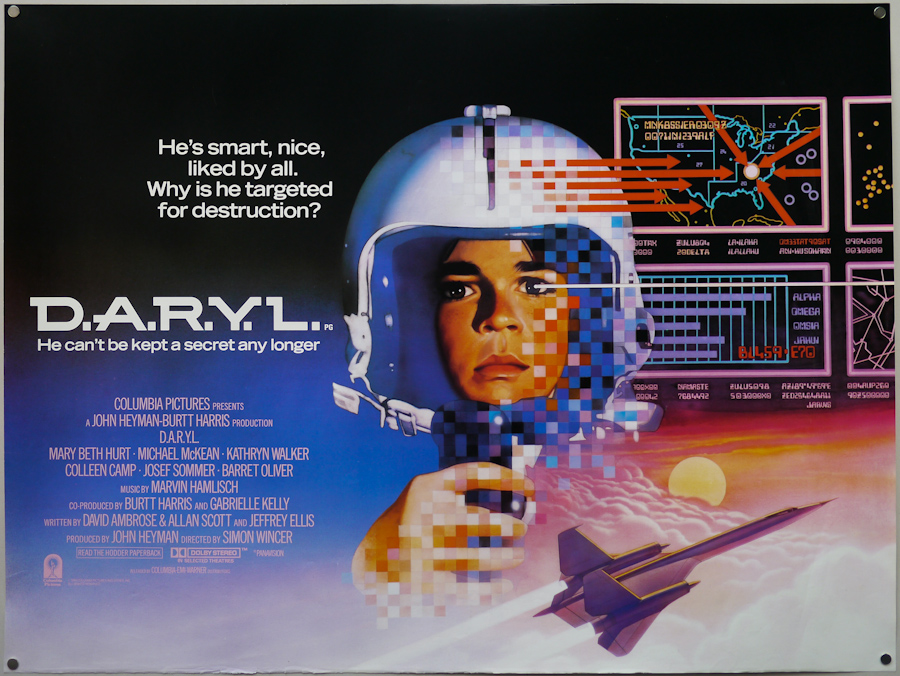
Film on Paper D.A.R.Y.L.
(via Ryan Gallagher.)
Halo 4 is Better Than Cinema, Says Halo's Promo
This afternoon, my pal Rafi alerted me to a Halo 4 promo that is currently running before trailers in US movie theaters. I went to look it up and found two versions: an official one without voice-over from Microsoft’s official Xbox YouTube account and a bootleg from this year’s Comic-Con posted by the Little English Halo Blog featuring the narration that plays in theaters.
I don’t know why Microsoft is only playing the narration publicly, but for the sake of simplicty I cut the higher quality video with the Comic-Con voiceover and uploaded it to YouTube. Here it is:
The transcript is below, but before that, some perspective:
Arthur Miller's first and, I think, only novel, Focus, was, in my opinion, every bit as good as his first produced play, All My Sons. I once asked him why, if he was equally talented in both forms, he chose to write plays. Why would he give up the total control of the creative process that a novel provides to write instead for communal control, where a play would first go into the hands of a director and then pass into the hands of a cast, set designer, producer, and so forth? his answer was touching. He said that he loved seeing what his work evoked in others. The results could contain revelations, feelings, and ideas that he never knew existed when he wrote the play. It's what we all hope for.
I never thought about pitting movies against video games, but I’m thinking about it now. So, good work Microsoft?
Transcript:
Creating Halo 4, in many ways, is a little like making a movie. There are a lot of the same components, a lot of the same technology, a lot of the same kinds of artists and musicians and designers. On Halo 4, a significant portion of the game studio's staff had movie backgrounds; skills and talent they've honed and polished in Hollywood on major theatrical productions and blockbuster movies. This game has motion capture specialists, people who capture fluid animation and occasionally, alien movement. Halo has a sweeping, soaring, cinematic score that pulls audiences into the emotion and action on the screen. They record that soundtrack with a sixty piece orchestra at Abbey Road Studios, the recording venue for Star Wars, Prometheus and The Avengers. Halo 4 has artists whose sole job is to create beautiful, compelling environments, worlds that, like the matte paintings from the golden age of cinema, make you feel like you've entered another world. Halo has prop builders and set designers, people whose mission is to craft incredible weapons and build legendary vehicles. So yes, in some ways, making a video game is a little like making a movie, but, a movie, like a game, is a collaborative process with millions of moving parts. A movie is a singular vision, experienced in the same way every time. It's a journey that the director takes you on, but in Halo 4, you're the director. You are the star. We'll give you the tools to blaze a new trail and allow you to experience and inhabit worlds and heroes in a way a movie never can. It's your journey. You control your own destiny, and there's no magic quite like it.