A Brief History of Time is Online ⇒
Errol Morris’ 1991 film on Stephen Hawking with a score by Philip Glass is on YouTube.
{% youtube AeaIHB5mBqU %}
The film is difficult, if not impossible, to find on DVD and isn't available on Netflix, Amazon Instant Video, or iTunes. And as far as I can tell, the soundtrack was never released either.
Haven’t watched this yet, but I’ll bet it’s worth downloading in case YouTube pulls it. Can’t wait to see it.
I Guess I'm Not Seeing The Dark Knight Rises at Midnight ⇒
Thursday July 19 midnight shows for The Dark Knight Rises: The IMAX Experience have already sold out at New York’s AMC Loews Lincoln Square theater. The AMC Loews Universal City cineplex in Los Angeles has sold out all seats and all but two wheelchair slots, according to seating charts for advance sales via Fandango.
That’s the only true IMAX in New York City. I’m not a huge Nolan/Knight nerd, but I am a sucker for the only innovation happening in celluloid these days (i.e. IMAX’s 70mm acquisition and projection). Maybe they’ll add a 3 a.m. showing.
Reusing Musical Cues for a Contest ⇒
Earlier this week Kim Novak very publicly said she felt raped (her word) by the use of Bernard Herrmann’s Vertigo score in The Artist. The editors at Press Play hate the casual use of that word and have concocted a great little contest to test the boundaries of reusing musical cues:
1. Take the same Herrmann cue -- "Scene D'Amour," used in this memorable moment from Vertigo -- and match it with a film clip from any film. (You can nick the three-minute section from one of Kevin's mash-ups if it makes things easier.) 2. Although you can use any portion of "Scene D'Amour" as your soundtrack, the movie clip that you pair it with cannot have ANY edits; it must play straight through over the Herrmann music. This is an exercise in juxtaposition and timing. If you slice and dice the film clip to make things "work," it's cheating. MONTAGES WILL BE DISQUALIFIED.
Press Play is really a groundbreaking criticism site. If you haven’t checked out their work, Last September’s IN THE CUT: The Dark Knight by Jim Emerson is a good entry-point, but they’ve been up to a lot since.
More than a new design
There’s just something about the new year that gets me a bit twitchy about the design of the candler blog. I have re-designed the site every year since it launched in 2009. Let’s look back.
2009
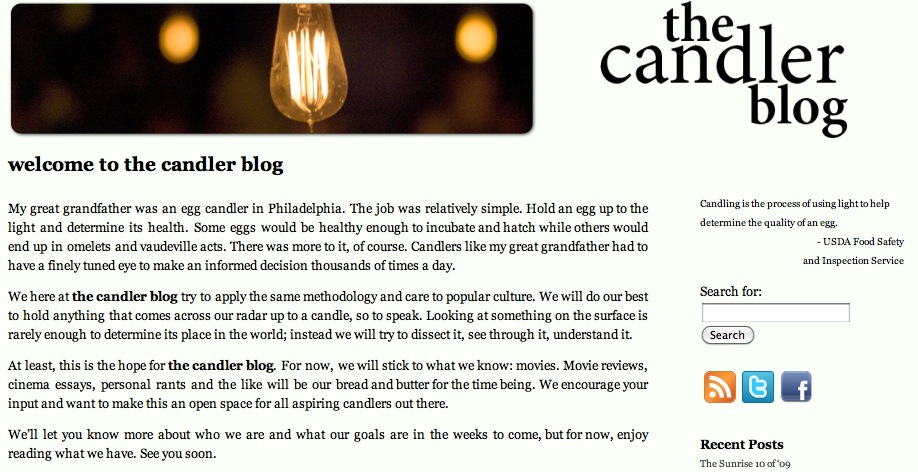
2010
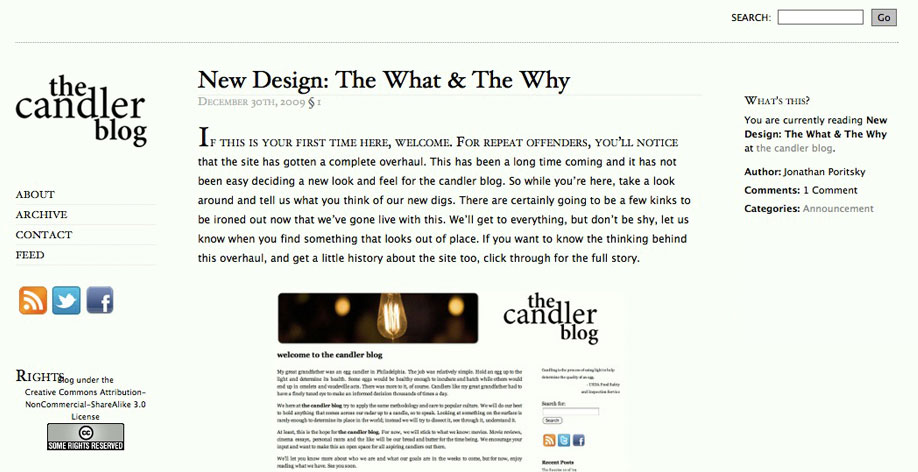
2011
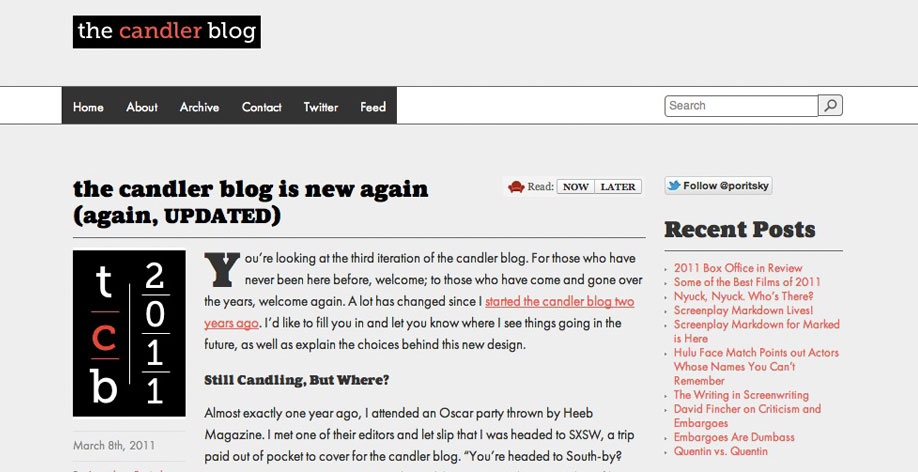
Perhaps you’ve noticed things look radically different around here. That’s because I’ve done more than just redesign the site this time around, I’ve switched blogging platforms completely. The candler blog has been on Wordpress since it launched, but that’s changing today.
I’ve decided to go with the somewhat nerdy Octopress, a framework built on top of Jekyll. Those probably aren’t household names yet. I was taken with its beautiful stock theme and its powerful templating engine. This is cutting edge stuff and, well, I want to be a part of it.
But I don’t want to get too much into what’s going on under the hood here (yet). What struck me about the look of Octopress’s main theme was not only how big and readable it is, but how responsive it is. I’d been looking to build a new design on Wordpress that would allow users to load the site on an iPad or mobile phone, automatically reformatting it to look better. It was taking me too long to find exactly what I wanted for the look of the site on wordpress and I kept coming back to Octopress’s design.
So I jumped ship. Here it is, your candler blog from 2012 onward (or until I get twitchy again).
A few things. Since this is a big change I anticipate a lot of problems transitioning the entire site. I already know for a fact that many of the posts are ill-formatted, have dead links or are missing images. Bear with me as I work to fix them. If you see something that’s broken and would like to give a hand, you can contact me directly or use the “Report Problems” form in the sidebar.
I launched the new design knowing it would be rocky, but I had to do it sometime. I haven’t written in almost two weeks, during which time I’ve been prepping this launch (and learning that the command line can be my friend) and I wanted to just get it out there and share it with you.
And that’s about it. Thanks for reading. Come back soon. 2012 is going to be an exciting year for the candler blog.
2011 Box Office in Review
The door on 2011 is closing. Now that most of our “best of” lists are out in the open, it’s time to talk about the year’s box office. The chatter all week has been about Hollywood’s weak ticket sales, at their lowest since 1995. What’s amazing is that one of the generally ignored metrics, actual tickets sold, has come to the fore this year. This is a great development since inflated (engorged, really) ticket prices make revenues an impossible metric to go by anymore. How many people saw a particular movie? Now there’s a measurement that never goes out of style.
Unless about half the U.S. hits the multiplexes today, our fate is sealed. So why are fewer people going to the movies?
In the New York Times, Michael Cieply places the blame squarely on the preponderance of sequels and reboots at the box office.
So far the top seven pictures at the domestic box office have been sequels, an alignment that appears unmatched in movie history. […] The strong opening for “Mission: Impossible — Ghost Protocol” suggests that it may well join a list that also includes “Rise of the Planet of the Apes,” from yet another film series, in the ninth position. If “Sherlock Holmes: A Game of Shadows” or “Alvin and the Chipmunks: Chipwrecked” gain traction, the year’s entire Top 10 may turn out to have been sequels…
The glut of franchise pictures in theaters has become a perennial complaint, but is it really all that new of a trend? Ticket sales have been on a steady decline since 2002, with the only glimmer of hope in that time being 2009 (aka Avatar and Transformers 2 year). I’ve pulled and modified a chart from The Numbers analyzing the top grossing films of the last 16 years. Bolded films are sequels.
| Year | Top Grossing Film (Bold=Sequel) |
|---|---|
| 1995 | Batman Forever |
| 1996 | Independence Day |
| 1997 | Men in Black |
| 1998 | Titanic |
| 1999 | Star Wars Ep. I: The Phantom Menace |
| 2000 | How the Grinch Stole Christmas |
| 2001 | Harry Potter and the Sorcerer’s Stone |
| 2002 | Spider-Man |
| 2003 | Finding Nemo |
| 2004 | Shrek 2 |
| 2005 | Star Wars Ep. III: Revenge of the Sith |
| 2006 | Pirates of the Caribbean: Dead Man’s Chest |
| 2007 | Spider-Man 3 |
| 2008 | The Dark Knight |
| 2009 | Transformers: Revenge of the Fallen |
| 2010 | Toy Story 3 |
| 2011 | Harry Potter and the Deathly Hallows: Part II |
Hmm, I did say ticket sales have been on the decline since 2002 right? Consider that the last time there were this few tickets sold, the number one film was Joel Schumacher’s nipply addition to the Batman franchise. One could even make the argument that George Lucas’s Star Wars Episode I: The Phantom Menace was more of a reboot than a sequel, perhaps even an adapted or re-imagined work. If that’s the case, then look at the chart again. We see a bleak 1995 with a threequel on top, then a steady rise in sales on new work. Once the age of sequels revs up, ticket sales start going down again. Wouldn’t it seem obvious, then, that they’re a bad investment?
In his article, “I’ll tell you why movie revenue is dropping…,” Roger Ebert tries to lay out in plain English what he thinks is wrong with the movie industry. Unlike Cieply (and me), Ebert refrains from blaming the quality of the films being made.
Ticket prices are too high. People have always made that complaint, but historically the movies have been cheap compared to concerts, major league sports and restaurants. Not so much any longer.
So let’s talk about ticket prices.
| Year | Avg. Ticket Price |
% +/- | Adj. for Inflation |
% +/- Adj. |
|---|---|---|---|---|
| 1995 | $4.35 | N/A | $6.46 | N/A |
| 1996 | $4.42 | +1.61% | $6.37 | –1.39% |
| 1997 | $4.59 | +3.85% | $6.47 | +1.57% |
| 1998 | $4.69 | +2.18% | $6.51 | +0.62% |
| 1999 | $5.08 | +8.32% | $6.90 | +5.99% |
| 2000 | $5.39 | +6.10% | $7.08 | +2.61% |
| 2001 | $5.66 | +5.01% | $7.23 | +2.12% |
| 2002 | $5.81 | +2.65% | $7.31 | +1.11% |
| 2003 | $6.03 | +3.79% | $7.41 | +1.37% |
| 2004 | $6.21 | +2.99% | $7.44 | +0.40% |
| 2005 | $6.41 | +3.22% | $7.43 | –0.13% |
| 2006 | $6.55 | +2.18% | $7.35 | –1.08% |
| 2007 | $6.88 | +5.04% | $7.51 | +2.18% |
| 2008 | $7.18 | +4.36% | $7.54 | +0.40% |
| 2009 | $7.50 | +4.46% | $7.91 | +4.91% |
| 2010 | $7.89 | +5.20% | $8.19 | +3.54% |
| 2011 | $7.96 | +0.89% | $7.96 | –2.81% |
*Sources: MPAA via Box Office Mojo; Inflation calculated to 2011 dollars with BLS CPI Calculator.
This confirms what moviegoers have been feeling in their pocketbooks over the past few years: it does cost relatively more than it used to to go to the movies. After adjusting for inflation, average ticket prices have increased 23% from $6.46 in 1995 to $7.96 today, and that’s only the average. I can’t remember the last time I paid that little to go to a movie (at night).
Ebert smartly lays the blame, mostly, on theater owners.
Box-office tracking shows that the bright spot in 2011 was the performance of indie, foreign or documentary films. On many weekends, one or more of those titles captures first-place in per-screen average receipts. Yet most moviegoers outside large urban centers can’t find those titles in their local gigantiplex. Instead, all the shopping center compounds seem to be showing the same few overhyped disappointments. Those films open with big ad campaigns, play a couple of weeks, and disappear.
I’ve got a chart for that too:
| Per Screen Rank | Film | Gross | Per Screen Average | Gross Rank |
|---|---|---|---|---|
| 1 | Red State | $1,104,682 | $220,936 | 198 |
| 2 | Evil Bong 3-D | $91,260 | $91,260 | 344 |
| 3 | Harry Potter and the Deathly Hallows Part 2 | $381,011,219 | $87,088 | 1 |
| 4 | Transformers: Dark of the Moon | $352,390,543 | $86,201 | 2 |
| 5 | Wretches & Jabberers | $84,610 | $84,610 | 349 |
| 6 | Born to Be Wild (IMAX) | $14,844,138 | $71,366 | 121 |
| 7 | The Hangover Part II | $254,464,305 | $69,242 | 4 |
| 8 | The Twilight Saga: Breaking Dawn Part 1 | $272,684,000 | $67,064 | 3 |
| 9 | Pirates of the Caribbean: On Stranger Tides | $241,071,802 | $57,894 | 5 |
| 10 | Bridesmaids | $169,106,725 | $57,169 | 12 |
| 11 | The Help | $169,425,912 | $56,213 | 11 |
| 12 | The Tree of Life | $13,303,319 | $56,132 | 125 |
| 13 | Fast Five | $209,837,675 | $55,322 | 6 |
| 14 | Midnight in Paris | $56,341,186 | $54,279 | 53 |
| 15 | Passione | $255,355 | $51,071 | 274 |
| 16 | Rise of the Planet of the Apes | $176,711,822 | $47,876 | 9 |
| 17 | Tinker, Tailor, Soldier, Spy | $2,625,976 | $47,745 | 167 |
| 18 | Captain America: The First Avenger | $176,654,505 | $47,552 | 10 |
| 19 | Went The Day Well? (2011 re-release) | $47,214 | $47,214 | 393 |
| 20 | Cars 2 | $191,452,396 | $46,525 | 7 |
| 21 | Thor | $181,030,624 | $45,680 | 8 |
| 22 | Bill Cunningham New York | $1,510,026 | $44,413 | 185 |
| 23 | Cave of Forgotten Dreams | $5,256,974 | $42,740 | 147 |
| 24 | Kung Fu Panda 2 | $165,249,063 | $41,814 | 13 |
| 25 | The Smurfs | $142,614,158 | $41,615 | 17 |
**Source: Box Office Mojo.
What I’ve done here is ranked films based not on their total box office take, but instead on their per-screen average, the gross divided by the numbers of screens it opened on. This is a way to measure success on the micro instead of the macro level. Which films were most successful relative to the audiences they were available to?
It’s an imperfect scale, sure. For example, Evil Bong 3-D, Wretches & Jabberers and Went The Day Well? only opened on one screen each. Had they opened at a single other theater and no one came, they wouldn’t make the cut. Kevin Smith’s Red State featured an uncommon release method, making seeing the film an “experience” based on scarcity. The idea paid off as it hits number one on our rejiggered chart.
Take Terrence Malick’s The Tree of Life, a bold rumination on our emotional existence in the universe. By gross it is down at number 125 for the year, but account for the per-screen average and it hops up to number 12 on our chart. Woody Allen’s Midnight in Paris jumps from number 53 to 14; Werner Herzog’s Cave of Forgotten Dreams from 147 to 23. The scales tip in the direction of independent, original work
Does this mean that these films would be able to cultivate a wider audience if they were released en masse the way the Harry Potter and Twilight movies do? Not necessarily.1 It does, however, confirm Ebert’s belief that audiences are clamoring for something outside the status quo. Many smaller films are able to find audiences even if they are held back by the scale of their releases. Moviegoers fed up with sequel after sequel would probably love to have something a little different come to their towns.
Ultimately, this all points to an industry that is eating itself alive with overblown budgets and unsustainable release cycles. Audiences aren’t going to be able to justify the high price at the multiplex much longer, and they certainly aren’t going to sit around and wait for the next big “good enough” film forever. There is groundbreaking work to be made for every audience. Here’s hoping that in 2012, more of them light up more screens.
Happy New Year!
-
To be fair, it’s impressive how high Harry Potter and the Deathly Hallows Part 2 ranks per screen given the enormity of its release. Note that The Twilight Saga: Breaking Dawn Part 1 actually drops from the number 3 spot to number 8 per screen. Which one is the more valuable property? ↩
Some of the Best Films of 2011
I just filed my best films of 2011 votes for Indiewire’s Criticwire poll. I kind of hate putting these lists together. I can tell you I missed a great many films this year that probably deserve to be on this list. I’ll have more thoughts to share on the year soon, but I thought I would post the list I sent in this morning. See also my [Best of 5771: Film](http://heebmagazine.com /best-of-5771-film/29075) at Heeb Magazine.
Best Films
- Hugo (Martin Scorsese)
- The Artist (Michel Hazanavicius)
- Melancholia (Lars Von Trier)
- Attack the Block (Joe Cornish)
- Tree of Life (Terrence Malick)
- Rise of the Planet of the Apes (Rupert Wyatt)
- Turkey Bowl (Kyle Smith)
- Blackthorn (Mateo Gil)
- The Descendants (Alexander Payne)
- Bellflower (Evan Glodell)
Top Lead Performances
- George Clooney, The Descendants
- Christoph Waltz, Carnage
- Andy Serkis, Rise of the Planet of the Apes
- Sam Shepard, Blackthorn
- Michelle Williams, My Week With Marilyn
Top Supporting Performances
- Uggie, The Artist
Best Director
Martin Scorsese
Best Undistributed Films
- Bad Fever (Dustin Guy Defa)
- For the record, Kentucker Audley’s performance in Bad Fever was the best of the year, but as it hasn’t played for at least a week, he is ineligible.
- Policeman (Nadav Lapid)
Nyuck, Nyuck. Who's There?
Earlier this week the trailer for Bobby and Peter Farrelly’s The Three Stooges went live online. For a few hours before I could sit down and watch it, I saw my Twitter stream light up with anger and righteous indignation. Apparently the trailer sucked, the concept sucked and the Farrellys sucked. Epic fail or something.
So then I got a chance to watch it. Let’s actually do that again:
{% youtube MFeYUNHtUG0 %}
Like most of the complainers, I grew up watching “The Three Stooges.” Their physical gags were only outdone by their snappy dialogue.1 They were masters of comic form, even if they had a minimal range. Their comedy never got more complex than it needed to. They could be groundbreaking with a work like You Nazty Spy! but not elevate themselves to the level of, say, Ernst Lubitsch’s To Be or Not to Be.
Never growing out of their Vaudeville britches, we have relegated them to remain in the 1930s and 1940s forever, back when they were good. The Farrellys appear to have gone against this accepted wisdom and brought the Stooges into present day.
I don’t know much about the film outside of this trailer, so I can’t tell if the Farrellys are pulling a Brady Bunch Movie and anachronistically dropping the three numbskulls into modern times. It’s clear that they’re rehashing old jokes. From the looks of the trailer they’re sticking pretty closely to the source material. So it begs the question: what’s the big deal?
I realize that it seems odd and perhaps blasphemous to move the Stooges out of their golden age, but perhaps it’s necessary. Are the Stooges not timeless? Who’s to say they can’t be as enduring characters as Superman, James Bond or Doctor Who? Why should history have only one set of Stooges?
Finally, I’d like to answer the following tweet from Scott Weinberg:
Imagine if a filmmaker who loved comedy made a fun, funny, poignant biopic about the three stooges themselves. Now they can't.
— Scott Weinberg (@scottEweinberg) December 7, 2011
First off, that’s not true. See: Capote (2005) and Infamous (2006), Titanic (1996) and Titanic (1997). People will make whatever they like whenever they like. Also, there already is a Stooges biopic that hits roughly the chord Scott is looking for, James Frawley’s 2000 made-for-TV The Three Stooges starring Michael Chiklis and Evan Handler.2 The scene in which a petite woman bludgeons Curly in a hotel to a crowd of onlooking laughers is, to my mind, about as poignant as one can get about the Stooges.
But that’s not really my point. Why do we need another biopic about Moe, Larry, Curly, Shemp, Joe Besser and “Curly Joe” DeRita? What is the Stooges film we really need? For me, I think the Farrellys might be onto something here. They’re apparently unafraid of pissing off the “core” Stooge fans while doing their best to stick to the conventions of the comedy troupe’s bits. Maybe this is the Stooges film we need, if not the one everyone wants.
Screenplay Markdown Lives! ⇒
Stu’s SPMD update at Prolost:
What something like this needs most is users, and I’m thrilled that we’re at that stage that you, the Prolost reader, could use SPMD for your creative work. We need the feedback to keep this project going.
This really is only the beginning. Go [get SPMD for Marked](http://www.candlerblog.com/2011/12/08/screenplay-markdown-for-marked- is-here/) and tell us what you think. Also:
I’m so inspired by this whole process—four guys who have never met in person collaborated on making something awesome, and now it works.
Are we done? Not even close.
Ditto.
See also Brett’s [Calling Screenwriter Nerds](http://brettterpstra.com /calling-screenwriter-nerds/) and Martin’s SPMD, Screenplain and Marked.
Screenplay Markdown for Marked is Here
This is exciting. I’ve mentioned Stu Maschwitz’s Screenplay Markdown (SPMD) here a few times before. I’ve been smitten with the idea ever since he cooked it up in August. Thankfully, I’m not alone.
About a month ago, I tweeted asking if it would be possible to use Screenplay Markdown in Brett Terpstra’s excellent Markdown previewing app, Marked. To my surprise, Brett responded enthusiastically, then Stu got in touch as well. Before long we were all communicating, along with Martin Vilcans, whose command line utility, Screenplain, was the first to turn SPMD text files into formatted screenplays.1
In order to learn a new syntax, it helps to have a way to preview your output so you know you’re properly formatting your document. It took me about a year to learn Markdown because I didn’t have an application as easy and robust as Marked to show me what my formatted writings scribblings look like.
Markdown and SPMD aren’t that difficult to master, but once you do you realize how quickly you can get your thoughts out of your head and into a document, from anywhere. That’s the point. Marked makes it super simple to format your plain text document. Now Screenplay Markdown for Marked makes it as straightforward as possible to preview your formatted scripts.
So what does it look like? On the left is a sample script in TextEdit. On the right is the same script in Marked.
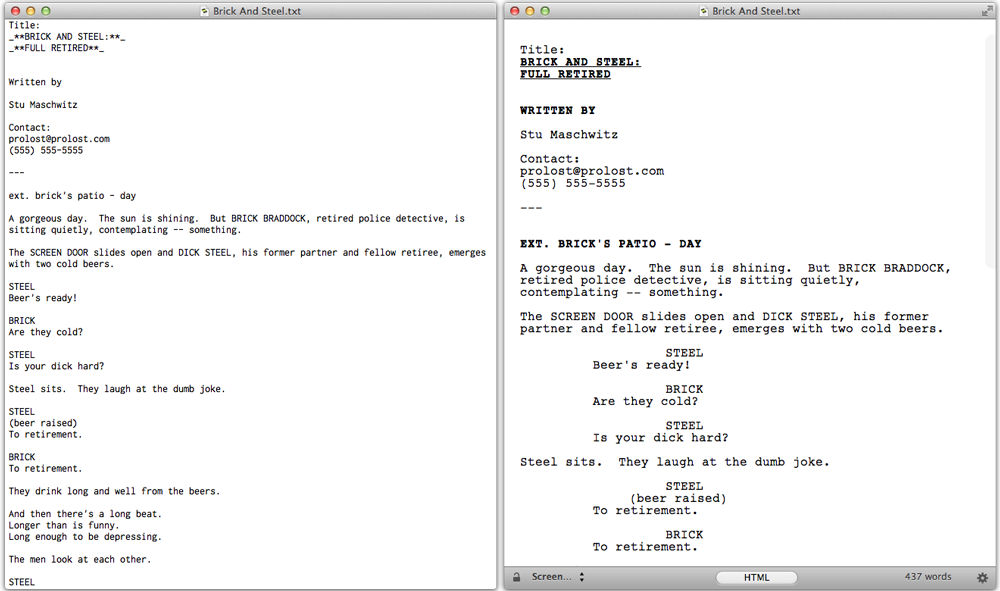
Screenplay Markdown for Marked is still missing some features, but it will only get better from here. Stu, Martin and Brett have all been working hard to make this a great solution for writing screenplays. This is feels like the beginning of a wider SPMD project. We value your input and feedback, so please leave comments here or on Twitter (or wherever) to let us know how you like using SPMD for Marked.2 Installation instructions are below and on the [Marked support site](http://support.markedapp.com/kb/how-to-tips-and-tricks /using-screenplay-markdown-with-marked). Go get Marked, the SPMD package below and your favorite text editor and write something already.
UPDATE 02/08/2012: Screenplay Markdown for Marked is now Fountain for Marked. Please visit the updated page for more information.
Download & Installation
-
Download SPMD_Marked.1.0.zip. -
Install the filesDouble click the .zip file to extract its contentsMovemarked-screenplainfolder to a folder of your choiceSuggestions: Your home folder,/usr/local/bin,~/Library/Application Support/MarkedMove the Screenplay.css file to~/Library/Application Support/Marked/Custom CSS/
-
Launch Marked and open Preferences -
In the Behavior panel, check the Custom Markdown Processor box and in the field below it, enter the path to screenplain_markedThis will be the full (no ~) UNIX path. If you put it in/usr/local/bin/it would be/usr/local/bin/marked-screenplain/bin/screenplain.If you put it in your users’s home folder, it would be:/Users//marked-screenplain/bin/screenplain
-
Go to the Style tab of PreferencesClick the plus button (+) under the table to add a new custom styleIn the file select dialog, navigate to~/Library/Application Support/Marked/Custom CSS/Screenplay Markdown.cssand add it
-
Open a Screenplay Markdown document.The custom processor you entered should be on by default. It can be toggled per-document using the gear menu or ⌥⌘C.Select the “Screenplay Markdown” style from the Style selector in the bottom left.
Notes:
This is a customized version of screenplain by Martin VilcansIt createsh2instead ofdivfor “slug” types to allow for TOC navigation in Preview (hover over the upper right edge of the preview)Currently there are no export abilities for formats other than PDF/HTMLPagination doesn’t work properly just yet. While you can print and export PDFs of your scripts, note that pages will not be numbered and may not accurately render (Characters may be on different pages than their dialogue, no “mores” or “continueds”, etc.). This may be fixed in future updates.
Icon
Check out this awesome SPMD for Marked icon Brett made. Download and enjoy.


-
The Screenplain web app can even quickly create FDX files from your SPMD scripts. It’s pretty awesome. ↩︎
-
Or don’t like, but be nice. ↩︎
Hulu Face Match Points out Actors Whose Names You Can't Remember ⇒
From Hulu’s [official blog](http://blog.hulu.com/2011/12/08/from-hulu-labs- face-match/):
When you turn it on, the Hulu Face Match Engine can tell you more about the actors in the video the instant they appear. Just hover the mouse over a character’s face, and the video will pause to tell you a little bit more about that guy whose name you just can’t remember.
We’re in the future. Neat.
(via Brooks Review)